






Table of Contents
“CBAM Roadmap for Business: From Transitional Reporting to Strategic Financial Liability”
January 1, 2026, the European Union’s Carbon Border Adjustment Mechanism (CBAM) has transitioned from a purely administrative reporting exercise into a definitive financial regime. Now let’s understand the CBAM and its impact on the market and business around the world.
For basic understanding, CBAM is the EU's tool to put a fair price on carbon emitted during the production of carbon-intensive goods that are entering the EU, and to encourage cleaner industrial production in non-EU countries. By applying a carbon price to specific imported goods, the EU prevents "carbon leakage" (companies moving production to countries with weaker climate rules) and incentivizes global industries to decarbonize. (Sectors under CBAM: iron and steel, cement, aluminum, fertilizers, electricity, and hydrogen)
However, this policy has significant implications for international trade, particularly concerning World Trade Organization (WTO) regulations and trade equality, as well as how the collected CBAM revenue will be further utilised in emission reduction strategies for other exporting countries.
Timeline and evolution of CBAM
The evolution of the CBAM progresses through four main stages, starting from its initial proposal in July 2021 as a measure to prevent carbon leakage. It officially entered a "transitional phase" in October 2023, which lasts until December 31, 2025, and strictly requires importers to report their embedded carbon emissions without imposing any financial obligations. Starting January 1, 2026, the mechanism enters its "definitive phase" and begins a gradual roll-out of financial liabilities, requiring importers to purchase and surrender CBAM certificates at an initial phase-in rate of 2.5%. This financial obligation will scale up incrementally each year (running in parallel with the phase-out of the EU ETS free allocations) until reaching full implementation in 2034, when importers will be responsible for 100% of the CBAM costs.

(Note: Phase in rate Can be defined as the "Slow Start" button. The EU knows that jumping from €0 to €100 per tonne of carbon overnight would wreck supply chains, so they are turning the dial slowly. The Phase-In Rate (often called the CBAM Factor) represents how much of the "Free Allowance" logic still applies.)
How is CBAM connected with suppliers’ domestic carbon market?
A critical feature of CBAM is its recognition of global efforts. It is not designed to be a double tax. If a producer in a country like India, China, or Canada has already paid a carbon price in their home country, whether through a carbon tax or a domestic emissions trading scheme that amount can be deducted from the CBAM obligation.
This creates a powerful incentive for nations to establish their own domestic carbon markets, ensuring that carbon revenues stay within their own borders rather than being collected by the EU at the border.
What are the methodology to calculate the CBAM cost?
CBAM Cost (€/t) = ([Direct EF (tCO2/t) - (Benchmark (tCO2/t) × Phase in Rate)] * EUA Price (€/tCO2)) - Carbon price paid overseas (€/t)
Total CBAM Cost (€) = Volume (tonnes) × CBAM Cost (€/t)
The total CBAM liability is primarily determined by the product's specific emission factor, which sets the baseline for the carbon footprint. This initial calculation is then adjusted by the EU’s annual phase-in rate, a scheduled percentage that gradually increases financial responsibility toward 2034. Finally, the net cost is further reduced by any carbon price already paid in the supplier’s domestic market, ensuring that only the "carbon gap" between the local and EU price is charged at the border.
Determining the emission factor is a critical step in the CBAM process, and it can be approached in two ways: using the EU’s default values or calculating actual emissions based on primary data from the manufacturer. It is essential to understand the distinction between these two, as the choice significantly impacts both the administrative burden on the supplier and the final cost for the importer.
What is Default value and Actual value of emission intensity benchmark?
CBAM exposure index, category and country wise comparison
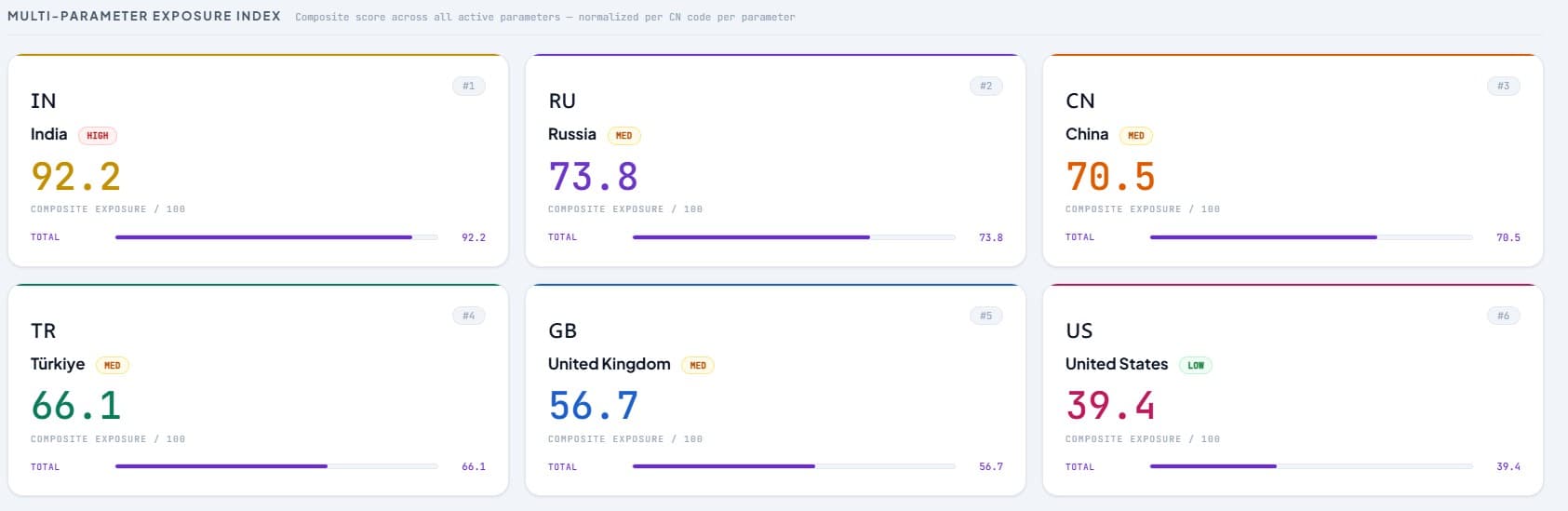
Our dashboard features a comprehensive CBAM Exposure Index, quantifying the regulatory risk for 22 key products across five critical sectors and six primary trading nations. By normalizing emission intensities relative to sector-specific and regional benchmarks, our analysis identifies India as having the highest total exposure, followed closely by Russia and China.

As per our analysis of default value of EU benchmark of four major Aluminium product, we found that China, India and Turkey has major impact with avaerge emission intensity above 3 Tco2/ton. While In India Aluminium bar and plates has maxiumum impacted category.

Similarly, in Iron and steel sector, we analysed 12 major category of product and their default value shows India has the maximum exposed with average emission intensity above 4.5 Tco2/ton, followed by china. We invite you to explore the interactive graphs and detailed dashboard at our website for a deeper look at our calculation methodology and the resulting exposure rankings.
At Acquis, we understand the complexity of these obligations and are committed to supporting and managing your CBAM compliance requirements. Our expert team works alongside you to navigate regulatory requirements, optimize your reporting, and ensure seamless integration of CBAM obligations into your supply chain operations and transforming regulatory challenges into competitive advantages.
(Note: All the graphs and charts are prepared by Author based on EU Default values datasheet released by EU on 13th February 2026. For more information on methodology please reach out to Acquis compliance and Click Here for full dashboard)
FAQ's
Q.1. What is the "Definitive Phase"?
Between 2023 and 2025, companies only had to report their emissions (the Transitional Phase). As of January 1, 2026, the "Definitive Phase" begins. This means companies must now pay for their carbon footprint by purchasing CBAM certificates.
Q.2. What are "CBAM Certificates"?
Think of these as digital "coupons" for carbon. Importers must buy a certificate for every tonne of $CO_2$ embedded in their products. The price of these certificates is tied directly to the EU ETS (Emissions Trading System) weekly average price.
Q.3. What is the "Phase-In Rate"?
Also known as the "CBAM Factor," this is a transition dial. In 2026, the EU isn't charging 100% of the carbon cost immediately. It starts at a 2.5% liability and scales up annually until 2034. It is designed to give supply chains time to adapt without collapsing.
Q.4. What are "Free Allowances" in the EU ETS?
The EU has given its own domestic industries a certain number of carbon permits for free. This was done to help them stay competitive against non-EU companies that didn't have to pay for carbon. In an ETS, covered entities may receive allowances for free from the government or buy them in auctions. Below are given the phase out of free allowances under CBAM to make EU and Non-EU players at equal level.

Q.5. What is the "CBAM Exposure Index"?
This is a ranking of how "at risk" a country or product is based on its carbon intensity. According to the article, India has the highest exposure in the Iron and Steel sector because its production methods currently emit more CO2 per tonne (average > 4.5 tCO_2/t) compared to other regions.
Q.6. Who is an "Authorized CBAM Declarant"?
You cannot simply ship goods and pay at the docks. An importer must apply for "Authorized Declarant" status to legally import CBAM-covered goods into the EU. This involves a rigorous registration process and annual reporting.