






Table of Contents
- What Is the IMDS System?
- What Is GADSL and Why Does It Matter
- Why IMDS & GADSL Is Critical
- What Do You Need for IMDS Compliance?
- IMDS and the ELV Directive – A Perfect Compliance Match
- What's New in IMDS 14.3 (2024 Update)
- What's Coming in IMDS 15: Carbon Footprint Transparency
- IMDS Reporting: Step-by-Step Process for Suppliers
- CAMDS The Chinese Equivalent to IMDS
- Top IMDS GADSL Compliance Challenges in 2025
- How Acquis Solves IMDS & GADSL Compliance at Scale
What Is the IMDS System?
The International Material Data System (IMDS) is the global database used by automotive OEMs and suppliers to report and manage material data across the entire vehicle lifecycle. Originally developed to support the EU End-of-Life Vehicle (ELV) Directive, IMDS is now an essential part of compliance for automotive manufacturers worldwide.
Every part used in a vehicle—down to its chemical substances—must be accounted for in IMDS. This ensures recyclability, tracks restricted substances, and enables proactive risk management across the automotive supply chain.
> Note: IMDS reporting is not only expected by EU OEMs but increasingly required by global automakers, including Toyota, GM, BMW, Stellantis, Honda, Ford, and Volkswagen.
What Is GADSL and Why Does It Matter
The Global Automotive Declarable Substance List (GADSL) defines substances that must be declared or are prohibited/restricted in automotive parts. GADSL is maintained by a global consortium of OEMs, suppliers, and industry groups.
- Declarable substances must be reported in IMDS if present above threshold levels (typically 0.1%).
- Prohibited or restricted substances must not be used unless exempted or justified.
Many substances on the GADSL are also regulated under:
GADSL updates typically occur annually, but tracking and implementing changes in supplier declarations is a continuous task.
Why IMDS & GADSL Is Critical
The automotive industry faces heightened regulatory scrutiny amid growing environmental and circular economy mandates. IMDS and GADSL help manufacturers ensure:
- Legal compliance with ELV Directive and similar global rules
- Safe removal of restricted substances
- Full traceability of materials for end-of-life recycling
- Risk mitigation from non-compliant suppliers
What Do You Need for IMDS Compliance?
To submit a valid IMDS declaration, companies must gather and verify:
- Product BOM (Bill of Materials)
- Material composition of each part
- Weight and substance-level breakdown
- Tree structure format:
- Component
- Material
- Substance
Each part must be mapped down to its raw substance level, and all data submitted via the IMDS platform to the target OEM.
IMDS and the ELV Directive – A Perfect Compliance Match
The IMDS system was created to help automotive OEMs and suppliers comply with the EU End-of-Life Vehicle (ELV) Directive (2000/53/EC). This directive requires that vehicles be at least 85% recyclable and 95% recoverable by weight. To meet these requirements, OEMs need full transparency into the material content of every component.
Here’s how IMDS supports ELV compliance:
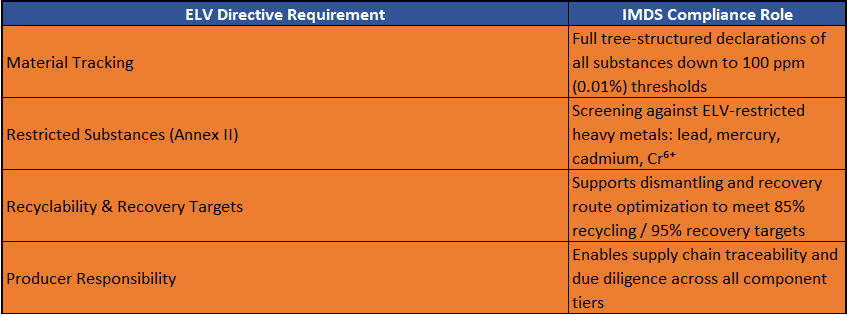
IMDS ensures that every nut, bolt, cable, and solder joint can be assessed for reuse, recycling, or safe disposal—driving true circularity.
What's New in IMDS 14.3 (2024 Update)
IMDS 14.3 introduced important functional upgrades that improve data accuracy, streamline reporting, and reduce supplier friction. Here's what changed:
- Bio-based content allowed under Classification 7.1 materials
- Dropdown menus added for selecting flame retardants and plasticizers
- Advanced MDS tree and classification search filters now available
- Supplier ID and version details shown directly in MDS check results
- Drawing number, change level, and drawing date fields now part of MDS report headers
- Recyclate validation updated: pre-consumer and post-consumer content now flagged independently to align better with ELV recyclability requirements
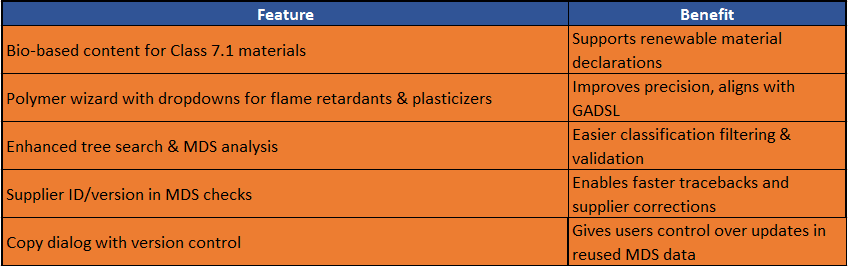
These enhancements reduce declaration rework and support stronger compliance with ELV, REACH, GADSL, and OEM-specific requirements.
What's Coming in IMDS 15: Carbon Footprint Transparency
IMDS 15, expected by the end of 2025, will introduce Product Carbon Footprint (PCF) reporting. This is part of a larger shift toward emissions transparency across the automotive value chain.
Here’s what to expect:
- Lifecycle GHG emissions reporting integrated directly into IMDS
- Aggregation of supplier carbon data across the MDS tree
- Methodologies aligned with PEFCR or KxK Rulebook
- Carbon data to support EU Green Deal, Digital Product Passport (DPP), and Scope 3 ESG requirements
If you're already using IMDS for material declarations, preparing for PCF now ensures your compliance workflows are future-ready.
IMDS Reporting: Step-by-Step Process for Suppliers
- Register with IMDS
- Get a Company ID via the IMDS portal
- Assign administrators and data entry users
- Collect Material Data
- Establish a structured BOM (tree format)
- Verify composition from suppliers
- Ensure thresholds for declarable substances are not exceeded
- Generate Material Datasheets (MDS)
- Create the IMDS entry using validated data
- Reference existing MDS or create new ones if needed
- Submit and Track
- Send the IMDS entry to the designated customer or OEM
- Address rejections or requests for clarification
CAMDS The Chinese Equivalent to IMDS
If you're manufacturing for China, you’ll also need to consider CAMDS (China Automotive Material Data System), developed by CATARC.
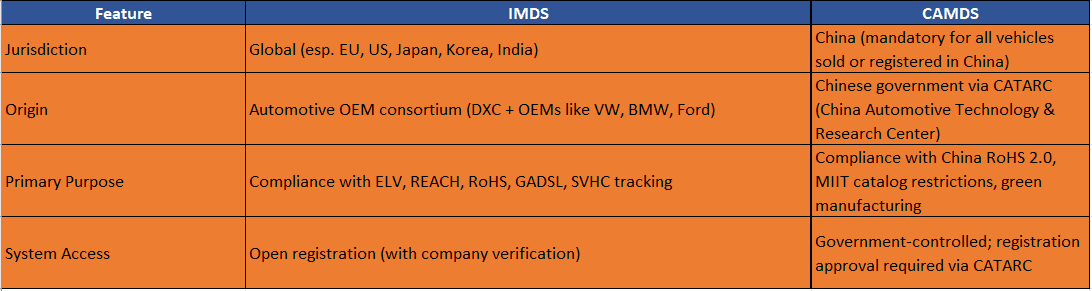
Most global suppliers now maintain dual submissions in IMDS and CAMDS to ensure full global market access.
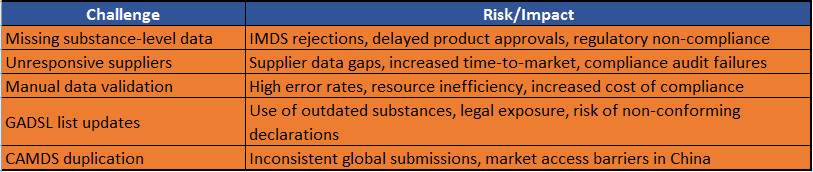
Top IMDS GADSL Compliance Challenges in 2025
How Acquis Solves IMDS & GADSL Compliance at Scale
Acquis automates the most painful parts of your compliance process:
- Supplier collaboration workflows
- IMDS & CAMDS-ready data formats
- Built-in GADSL screening engine
- Auto-validation against ELV and REACH thresholds
- Version tracking and audit trail
- Integrated compliance across ELV, REACH, Prop 65, and more
With Acquis, your engineering and compliance teams stay aligned and audit-ready, without chasing suppliers or wrestling with spreadsheets.
Streamline IMDS compliance across your supply chain
Book a free consultation with Acquis to see how our platform automates GADSL screening, supplier data collection, and IMDS/CAMDS integration in one seamless workflow.