






Table of Contents
If you're treating COO as a “Made in…” tag, you're missing the point. It’s a legal claim—and the foundation of your trade compliance.
What Is Country of Origin (COO)?
Country of Origin (COO) refers to the country where a product is manufactured, assembled, or substantially transformed. It determines:
- Import/export eligibility
- Tariff rates
- FTA benefits (like USMCA)
- Product labeling
- Buy American / BABA compliance
- Enforcement risk
COO is not about where the product ships from. It's about where it was actually made—or transformed into its final commercial form.
Why COO Is a Big Deal in 2025
With stricter customs enforcement, ESG due diligence laws, and FTA audits, COO is no longer just customs trivia—it’s legal exposure.
If you get it wrong:
- You lose trade benefits
- Your shipment gets held or fined
- You risk false origin claims and penalties
And if you can’t prove it? You’ve got a liability on your books.
How COO Is Determined (Legally)
1- Wholly Obtained or Produced
E.g., minerals mined, crops harvested, or products fully made in one country.
2- Substantial Transformation
Used when multiple countries are involved. The COO is the country where the product underwent a significant manufacturing process, resulting in a new name, character, or use.
> Example: Raw circuit boards sourced from China, transformed into full PCBs with firmware in Mexico = Mexico origin (if compliant with transformation rules).
3- Value-Based Rules (FTA-specific)
Some FTAs (like USMCA) use Regional Value Content (RVC) rules. If the percentage of regional content meets the threshold, the good qualifies under the agreement.
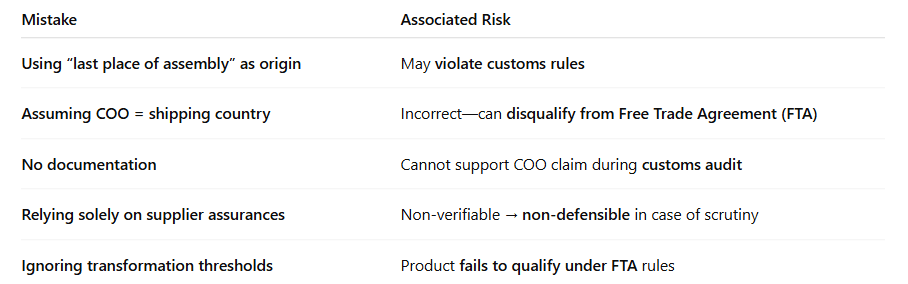
Common COO Mistakes & Their Risks
What COO Affects
- Customs declarations (HTS code + COO drives tariffs)
- FTA eligibility (USMCA, CAFTA, EU FTAs, etc.)
- Origin marking laws (e.g., “Made in USA” claims)
- Buy American / Buy America / BABA compliance
- ESG/sustainability disclosures (e.g., forced labor laws)
- SCIP, REACH, and CE reporting (EU traceability)
What You Must Maintain for COO
- Supplier origin declarations
- Bills of materials (BOM)
- Transformation process documentation
- RVC or tariff shift calculations (if applicable)
- Customs rulings or advance origin determinations
- Product-level COO database
How Acquis Automates COO Accuracy
With Acquis, you get:
- Centralized COO inquiry & collection from suppliers
- Product-level COO traceability linked to HTS, ECCN, and origin claims
- Audit-ready documentation for FTA, BABA, and customs
- Rule-based workflows for substantial transformation and RVC
- Country of origin risk maps (for ESG screening, forced labor laws, etc.)
Need to build a defensible COO into your compliance workflow? Talk to our COO compliance team →