






Table of Contents
CSRD / CSDDD Europe Hits “Pause” to Give Businesses Breathing Room
In a significant recalibration of Europe’s sustainability agenda, the European Commission and Parliament have formally extended multiple CSRD and CSDDD deadlines giving businesses extra time, but not an excuse to slow down.
Context: Why the EU Is Re-Sequencing Its Sustainability Rules
The Corporate Sustainability Reporting Directive (CSRD) and the Corporate Sustainability Due Diligence Directive (CSDDD) form the backbone of the EU’s sustainable-governance framework. Both laws impose far-reaching obligations: CSRD on disclosure (how companies report ESG data), and CSDDD on action (how companies manage sustainability risks in their value chains).
But as thousands of firms began implementation, it became clear that timelines were too aggressive. The Commission and Parliament responded with two separate but coordinated delays:
Phase 1: ESRS Adoption Delay (Directive (EU) 2024/498)
On 17 October 2023, the European Commission proposed to amend Directive 2013/34/EU to postpone the adoption of the sector-specific and third-country European Sustainability Reporting Standards (ESRS) from 30 June 2024 → 30 June 2026.
This change formally adopted as Directive (EU) 2024/498 and effective March 2024was the EU’s first “pause button.” It allows regulators and the European Financial Reporting Advisory Group (EFRAG) more time to finalise detailed standards, while companies focus on applying the first set of general ESRS already in force under Delegated Regulation 2023/2772.
Key takeaway: Businesses cannot postpone preparation. The two-year delay is intended to ease operational load, not eliminate it. Companies should be running data-gap analyses, refining double-materiality assessments, and aligning internal systems with the core ESRS now.
Sources: Directive (EU) 2024/498 | European Commission Press Release – 17 Oct 2023
⏸ Phase 2: “Stop-the-Clock” Directive (April 2025)
On 3 April 2025, the European Parliament approved the so-called “Stop-the-Clock” Directive, later confirmed by the Council of the EU on 14 April 2025 as part of the Omnibus I package. This measure formally delays CSRD and CSDDD application timelines to give companies additional implementation runway.
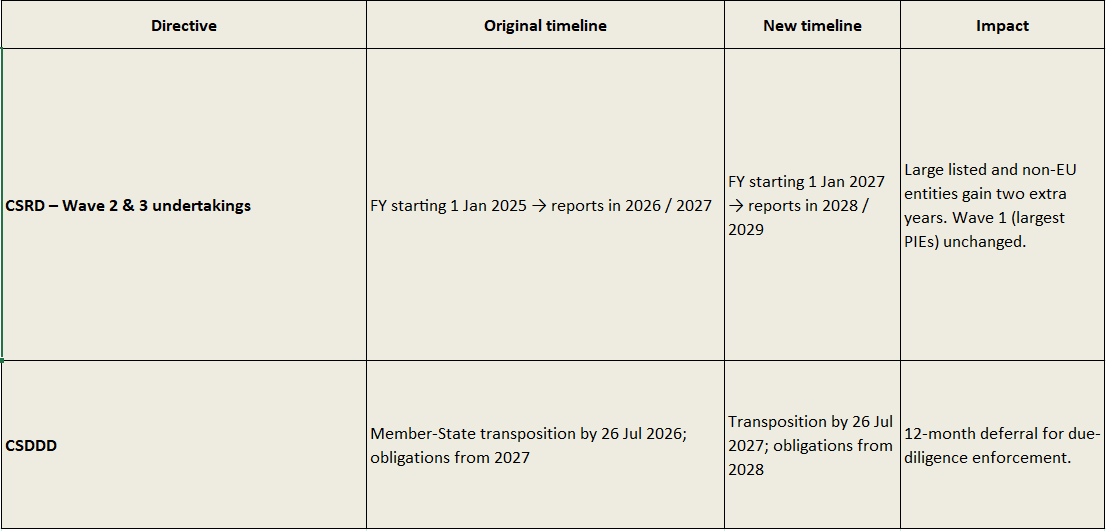
Why it matters: The EU acknowledges the scale of transformation required. The new timeline gives firms breathing space to stabilise data pipelines, supply-chain engagement, and assurance processes—without diluting the legal force of either directive.
Sources: European Parliament Press Release – 3 Apr 2025 | Council of the EU Adoption – 14 Apr 2025
Implications for Businesses
- Use the time—don’t waste it. Delays are designed to improve implementation quality. Companies that pause now will scramble later.
- Focus on readiness, not waiting. Build data-governance systems, align financial & sustainability reporting, and prepare for digital tagging under ESRS.
- Re-check your scope. Simplification discussions under Omnibus I may tweak size or turnover thresholds; reassess whether you remain in scope.
- Strengthen supply-chain due diligence. CSDDD’s extra year should be used to close supplier data gaps, integrate grievance mechanisms, and document remediation pathways.
- Communicate internally. Update board, audit committee, and investors on revised milestones—demonstrating control and proactive governance.
The Bigger Picture
Together, Directive (EU) 2024/498 and the April 2025 Stop-the-Clock Directive mark the EU’s attempt to sequence sustainability reforms realistically. They don’t water down the Green Deal— they make it survivable for business execution.
For companies, the message is simple:
> You’ve gained time, not immunity. > Build your systems now because enforcement will resume at full speed in 2027-2028.