






FLUKE
Kimball Electronics
Tolomatic
Industrial Scientific
AHEAD
roboception
FLUKE
Kimball Electronics
Tolomatic
Industrial Scientific
AHEAD
roboception
By Deepa Shetty | Tue Jul 1 2025 | 2 min read

If you’re not screening customers, suppliers, or end-users, you’re not compliant. You’re exposed.

Why Screening Matters More Than Ever

In today’s trade environment, it’s not just what you ship—it’s who you’re shipping to, who’s receiving it, and how it’ll be used.

With export control violations rising and global sanctions lists updating weekly, denied party screening (DPS) isn’t a best practice—it’s a legal obligation.

Skip it, and you’re risking:

  • Fines
  • Shipment seizures
  • Criminal penalties
  • Reputational damage

What Is Denied Party Screening?

Denied Party Screening (DPS) is the process of checking your transactions against global lists of:

  • Sanctioned individuals and entities
  • Blocked countries and regions
  • Restricted uses (e.g., military end use)

These lists are maintained by:

  • U.S. OFAC (SDN List)
  • U.S. BIS (Entity List, Unverified List)
  • U.S. State Dept. (DTC Debarred List)
  • EU Consolidated Sanctions List
  • UN Security Council Sanctions
  • APEC, UK, Japan, Canada, etc.

You must screen:

  • Customers
  • Vendors
  • Freight forwarders
  • End users
  • Shipping destinations
  • Financial intermediaries

Who’s Liable?

You are.

It doesn’t matter if the violation was accidental. Under strict liability, even an unintentional shipment to a blocked party can trigger enforcement.

If you're exporting U.S.-origin items, even from overseas, you’re still subject to U.S. rules.

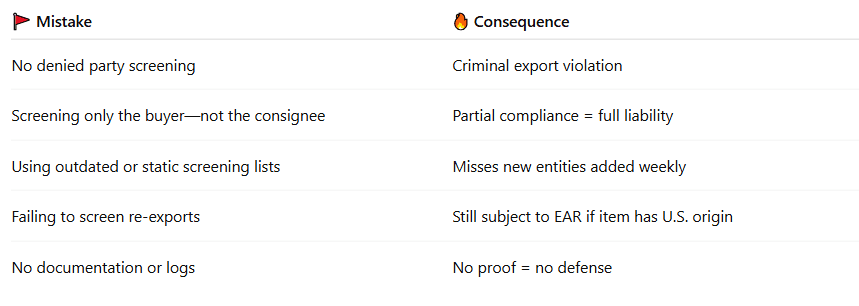
What Gets You Penalized
What Gets You Penalized.PNG

Who Needs to Screen?

  • Exporters / Importers
  • OEMs shipping internationally
  • Freight forwarders & 3PLs
  • Software providers (especially encryption)
  • SaaS platforms with global users
  • Banks, insurers, and fintech firms
  • Any U.S. or foreign company using U.S.-origin items

If your compliance team doesn't know what lists you're screening against or how often, you're already at risk.

How Screening Should Work

What to Screen:

  • Company name
  • Individuals (directors, UBOs)
  • Country of destination
  • End-use declarations

When to Screen:

  • At customer onboarding
  • Before every shipment
  • When supplier data changes
  • Before any financial transaction

What to Keep:

  • Screening logs
  • Match resolution notes
  • Timestamped audit trail

How Acquis Automates Sanctions Screening

With Acquis, you can:

  • Screen entities across 400+ global watchlists
  • Automatically flag hits by confidence score
  • Create a full audit trail for every shipment
  • Tie screening into COO, ECCN, and HTS classification workflows
  • Align with U.S., EU, and UN compliance frameworks

Want to avoid red flags before they cross your border? Talk to our compliance team →

Speak to Our Compliance Experts

Questions about compliance, partnerships, or support? We're here to help.

Share

Sanctions and Denied Party Screening: Your First Line of Defense in Global Trade

Denied Party Screening is the process of verifying that counterparties—such as customers, suppliers, or freight forwarders—are not listed on any global watchlists (e.g. OFAC, BIS, UN, EU). It’s a legal obligation under export and sanctions laws and helps prevent fines, license revocation, criminal liability, and reputational harm.
Compliant programs screen against over 400+ global lists, including: U.S. OFAC SDN List BIS Entity, Unverified, and Military End-User Lists EU and UN consolidated sanctions Interpol, World Bank, and other country-specific watchlists. Periodic rescreening is necessary because lists are updated daily
Every department may interact with external stakeholders—so screening should extend beyond trade compliance teams to: Legal, HR (new hires), Sales (prospects), Procurement (new suppliers) Facilities (visitors), M&A teams, and financial counterparties. This ensures enterprise-wide visibility and risk reduction.
Best practice dictates: Screening at onboarding (supplier, customer, hire) Pre-shipment and before any contract or payment Automated rescreening at least daily or weekly especially for long-cycle transactions to catch newly listed parties
A robust audit trail captures: Who conducted the screening and when Exact search criteria used and list results Match resolution actions and outcomes This serves as verifiable evidence of “reasonable care” during compliance audits.
Non-compliance with denied/sanctions screening laws can result in: Civil and criminal enforcement Fines (e.g. millions of dollars under U.S. law) Loss of export privileges Seizure of goods and damage to corporate reputation. Strict liability enforcement applies even if the sanction breach was unintentional.
Look for solutions that offer: Coverage of 750+ global lists, Advanced matching with minimized false positives, Rule customization and AI-assisted screening, Seamless integration with ERP/CRM tools (e.g., Salesforce, SAP), Dynamic, ongoing rescreening capabilities, Centralized dashboards and audit logs. Evaluating vendor features alongside business-specific workflows ensures cost-effective alignment.