






Table of Contents
If you're exporting dual-use items and you don’t know your ECCN, you’re not shipping. You’re gambling.
What Is an ECCN?
ECCN stands for Export Control Classification Number. It’s a 5-character alphanumeric code used under the U.S. Export Administration Regulations (EAR) to identify items subject to export control due to:
- National security
- Nuclear nonproliferation
- Anti-terrorism
- Encryption
- Regional stability
- Missile tech, crime, or chemical/biological controls
If you manufacture or export electronics, software, encryption, sensors, lasers, or defense-related tech—you probably need an ECCN.
ECCN Structure Breakdown
Example: 3A001
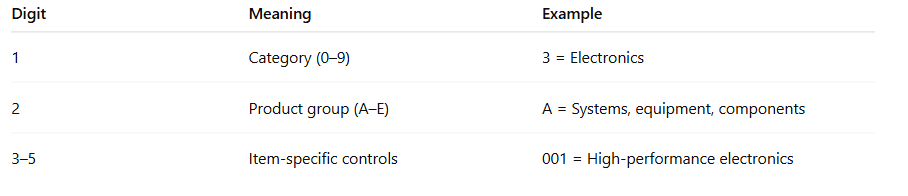
There are ten categories (0–9) and five product groups (A–E), such as:
- A – Equipment, assemblies
- B – Test equipment
- C – Materials
- D – Software
- E – Technology
🔎 ECCN vs EAR99
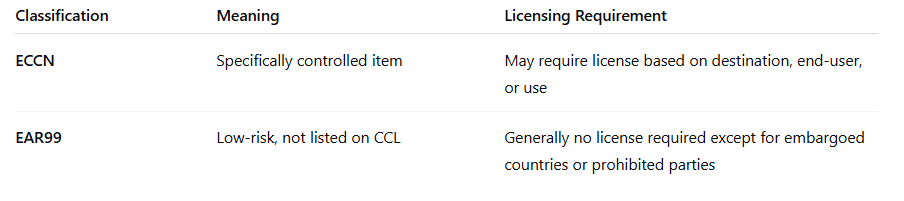
Don't assume you're EAR99 just because your product seems “non-sensitive.” Software and encryption tech often get flagged under ECCNs.
When Do You Need an ECCN?
You must classify your product under the Commerce Control List (CCL) if:
- You're exporting from the U.S.
- You're transferring tech to a foreign national (deemed export)
- You’re selling dual-use tech (civilian + military use)
- You're working with overseas subsidiaries or R\&D teams
And if your item has an ECCN, you may need:
- An export license, OR
- To qualify under License Exception (ENC, TSR, LVS, etc.)
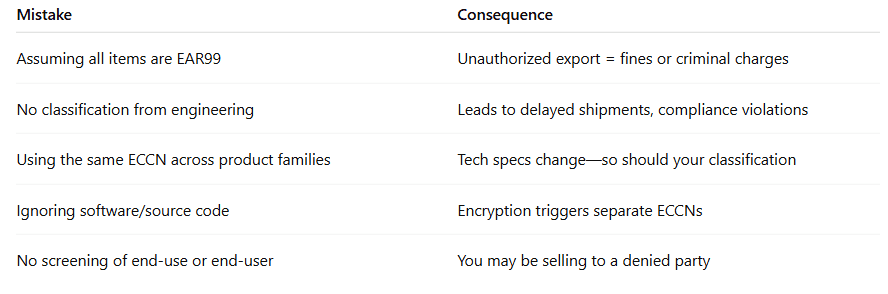
Common Export Control Mistakes
How to Classify for ECCN
Step 1 — Analyze Your Product
- What does it do?
- Is it controlled due to performance, function, or encryption?
- Is it a dual-use or defense-related item?
Step 2 — Check the Commerce Control List (CCL)
- Search by category (0–9)
- Match product group (A–E)
- Look for performance thresholds
Step 3 — Request a CCATS (if needed)
If you're unsure, file a Commodity Classification Request (CCATS) with BIS.
Step 4 — Document & Automate
- Store ECCN at the product level
- Link ECCN to COO, HTS, license requirements, and screening tools
What ECCN Classification Impacts
- Export license needs
- License exception eligibility
- End-use screening
- Deemed exports (e.g., engineers in foreign offices)
- Encryption reporting to BIS
- FTA eligibility (yes, really)
How Acquis Helps You Get ECCN Right
With Acquis:
- Get ECCNs mapped at the component level
- Automate dual-use checks during product onboarding
- Link ECCNs with HTS codes, COO, and denied party screening
- Track CCATS and license exception status
Need to classify controlled electronics, semiconductors, or encryption software? Talk to our ECCN experts →