






Table of Contents
- What Is the EU MDR?
- Key Objectives of the MDR
- Who Is Impacted by the MDR?
- Device Classification Under MDR
- Substance Restrictions and SVHC Reporting
- Transition From MDD to MDR
- EU MDR Labeling and Language Requirements
- The Role of Notified Bodies
- CE Marking Under MDR
- EUDAMED: The Central EU Device Database
- EU MDR Non-Compliance Risks
- How Acquis Helps You Get EU MDR-Ready
If you’re manufacturing or selling medical devices in the EU and still think you’re operating under the old MDD rules, you’re already behind.
The EU Medical Device Regulation (EU MDR 2017/745) officially replaced the Medical Device Directive (MDD) and Active Implantable Medical Device Directive (AIMDD) on May 26, 2021. It’s no longer about baseline documentation or minimal CE labels — the MDR brings a full regulatory overhaul, reclassifying risk, raising evidence standards, and demanding full transparency across the device lifecycle.
And it’s not just about Europe anymore — the ripple effects are global.
What Is the EU MDR?
The EU MDR (Regulation (EU) 2017/745) governs the placing of medical devices on the EU market, replacing previous directives (MDD and AIMDD). Its goal: ensure the safety, quality, and traceability of medical devices across the full product lifecycle.
Unlike directives, regulations like the MDR are directly applicable across all EU member states — meaning there's no national interpretation or delay.
Key Objectives of the MDR
- Strengthen clinical evidence and post-market surveillance
- Increase device traceability through UDI and EUDAMED
- Expand scope to include cosmetic and non-medical devices
- Improve transparency for healthcare professionals and patients
- Align with EU’s REACH and SVHC chemical restrictions
Who Is Impacted by the MDR?
If you're any of the following, you're directly in scope:
- Medical Device Manufacturers (inside or outside the EU)
- Importers, Distributors, Authorized Representatives
- OEMs and Private Labelers
- Economic Operators handling packaging, labelling, or instructions
And yes, non-EU companies selling into Europe must comply via an EU Authorized Representative.
Device Classification Under MDR
The MDR revises and tightens the risk classification system. Devices are now categorized under:
- Class I – Low risk (non-invasive devices like bandages)
- Class IIa / IIb – Medium risk (surgical instruments, infusion pumps)
- Class III – High risk (implantables, life-support systems)
Key change? Many previously Class I devices under MDD are now reclassified to higher classes, requiring involvement of Notified Bodies and increased clinical evidence.
Substance Restrictions and SVHC Reporting
Here's where things get serious for compliance officers:
If your device contains any substances on the REACH SVHC Candidate List above 0.1% w/w, you must:
- Disclose the substance name
- Justify its use
- Demonstrate safe use via risk analysis
- Notify EUDAMED
- Label the packaging accordingly
This includes carcinogenic, mutagenic, toxic-to-reproduction substances (CMRs), endocrine disruptors, and other REACH-regulated chemicals.
Failing to disclose can lead to Notified Body rejection, market bans, or product recalls.
Transition From MDD to MDR
This wasn’t a small revision — it was a full reset. Key shifts:
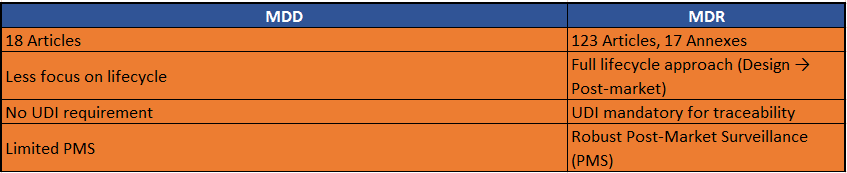
Devices certified under the MDD can only remain on the market until their certificate expires or until May 2024 (grace period extensions apply only if specific conditions are met).
EU MDR Labeling and Language Requirements
Labeling is now standardized and far stricter:
- Label must identify the device as “medical device” or “in vitro diagnostic medical device”
- Clear UDI placement on packaging and device itself
- Language translations required for all EU languages of the country of sale
- Indication of hazardous substances, CMRs, and sterilization methods
- Instructions for use must be in printed or digital form — and understandable to lay users for Class I/IIa devices
The Role of Notified Bodies
Notified Bodies (NBs) are your gatekeepers.
Under MDR:
- More devices require NB review — even many Class I devices
- NBs assess technical documentation, clinical data, labeling, and PMS plans
- Audits are more frequent and deeper
- Notified Bodies must be designated under MDR (many from the MDD era weren’t re-accredited)
Shortage of designated NBs = long wait times = plan early.
CE Marking Under MDR
CE Marking remains your entry passport to the EU market, but it now requires:
- Full technical documentation (Annex II + III)
- Device risk classification and conformity assessment route
- Clinical evaluation with performance claims and post-market clinical follow-up (PMCF)
- NB certification (for most classes)
The Declaration of Conformity (DoC) must be updated to reference MDR, not MDD.
EUDAMED: The Central EU Device Database
EUDAMED is the EU’s central transparency portal for medical devices. It includes:
- UDI Registration
- Actor Registration
- Device and Certificate Modules
- Vigilance, Clinical Trials, and PMS data
Companies must submit structured data to EUDAMED via machine-readable formats. It’s a key part of the EU’s digital compliance infrastructure.
EU MDR Non-Compliance Risks
Let’s be blunt — the risks of ignoring EU MDR are real:
- Loss of EU market access
- Product recalls or shipment blocks
- Invalid CE mark
- Contract termination with hospitals, clinics, and group purchasing organizations
- Reputational damage
Regulators aren’t waiting. Enforcement is happening.
How Acquis Helps You Get EU MDR-Ready
Acquis simplifies MDR compliance with tools that automate your regulatory processes:
- Material data gathering for SVHC thresholds
- Technical documentation builder aligned with MDR Annexes
- Full Material Disclosure (FMD) workflows for traceability
- Audit trail + version control for all declarations
- Supplier engagement at scale, even across non-EU vendors
With Acquis, medical device companies can go beyond checkboxes and build a scalable, defensible MDR compliance program — while staying aligned with REACH, RoHS, and global frameworks.
Talk to our regulatory experts today and get your MDR strategy on track.