






Table of Contents
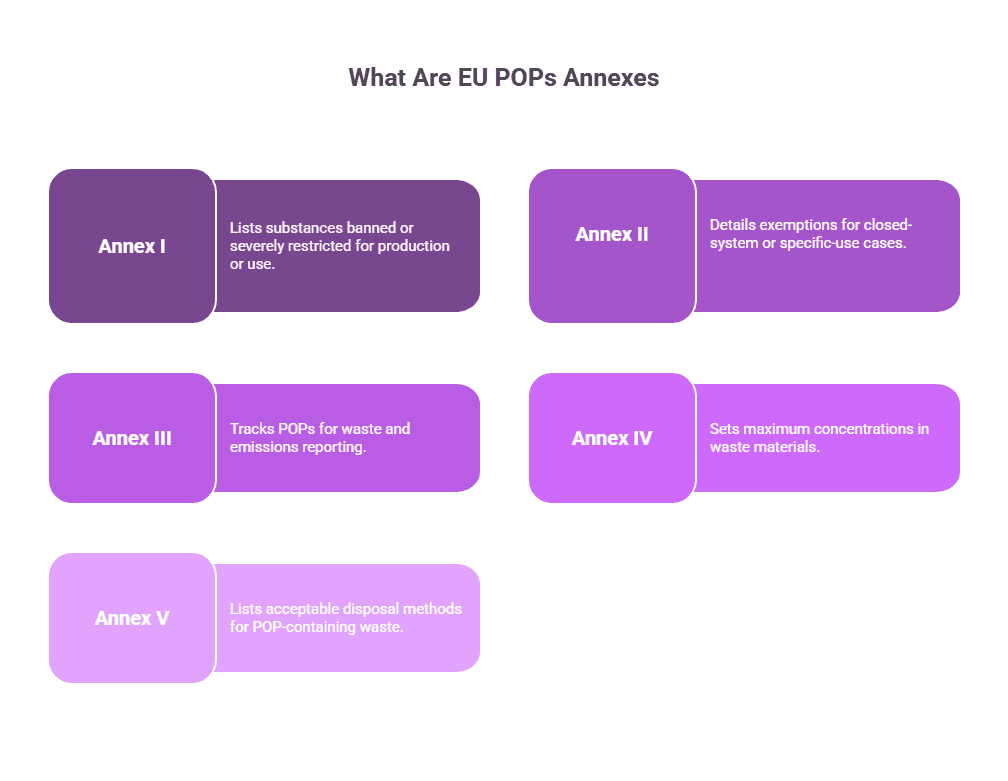
The EU POPs Regulation (EU) 2019/1021 plays a critical role in eliminating or restricting Persistent Organic Pollutants (POPs) across the European market. With recent amendments in 2023, 2024, and 2025, manufacturers, importers, and waste handlers must align with new thresholds and substance listings under Annex I (substance restrictions) and Annex IV (waste limits).
What Are EU POPs Annexes?
Latest Annex I Additions and Updates (2023–2025)
- 1 Methoxychlor
- Added: September 2024
- Used in: Agricultural pesticides
- Limit: 0.01 mg/kg (trace level)
- Impact: Agrochemicals and legacy waste
- 2 PFHxS, Its Salts, and Related Compounds
- Added: August 2023
- Includes: Branched isomers, salts, degradation products (C6F13S-)
- Limit: 0.025 mg/kg
- Use Cases: Electronics, textiles, firefighting foams
- 3 UV-328
- Added: May 2025
- Used in: Plastics, rubber, coatings
- Limit:
- 100 mg/kg (immediate)
- 10 mg/kg (after 2 years)
- 1 mg/kg (after 4 years)
- Note: Arctic environmental risk
- 4 Dechlorane Plus
- Added: May 2025
- Used in: Flame retardant for electronics
- Limit:
- 1000 mg/kg (first 30 months)
- 1 mg/kg after
- Exemptions: Aerospace, critical safety applications
- 5 Hexabromocyclododecane (HBCDD)
- Updated: September 2024
- New Limit: 75 mg/kg (was 100 mg/kg)
- Exception: Recycled EPS/XPS in construction may use up to 100 mg/kg
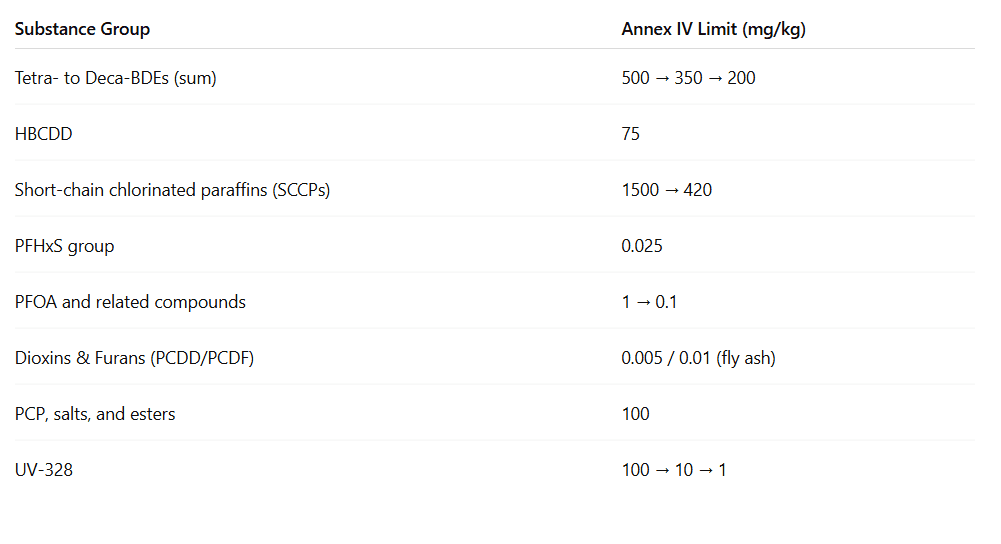
Annex IV Waste Thresholds (2025 Enforcement)
If these thresholds are exceeded, destruction via Annex V methods is mandatory. Reuse or recycling is prohibited.
Why These Changes Matter
- Tightened Controls
Lower thresholds reflect increased regulatory scrutiny and improved detection methods, especially for substances with long-range environmental mobility.
- Circular Economy vs. Safety
While HBCDD can still be used in recycled polystyrene, controls are strict. It’s a balancing act between material reuse and public health.
- Global Harmonization
The EU continues to align with the Stockholm Convention, adding PFHxS, Methoxychlor, and UV-328 in sync with global chemical management efforts.
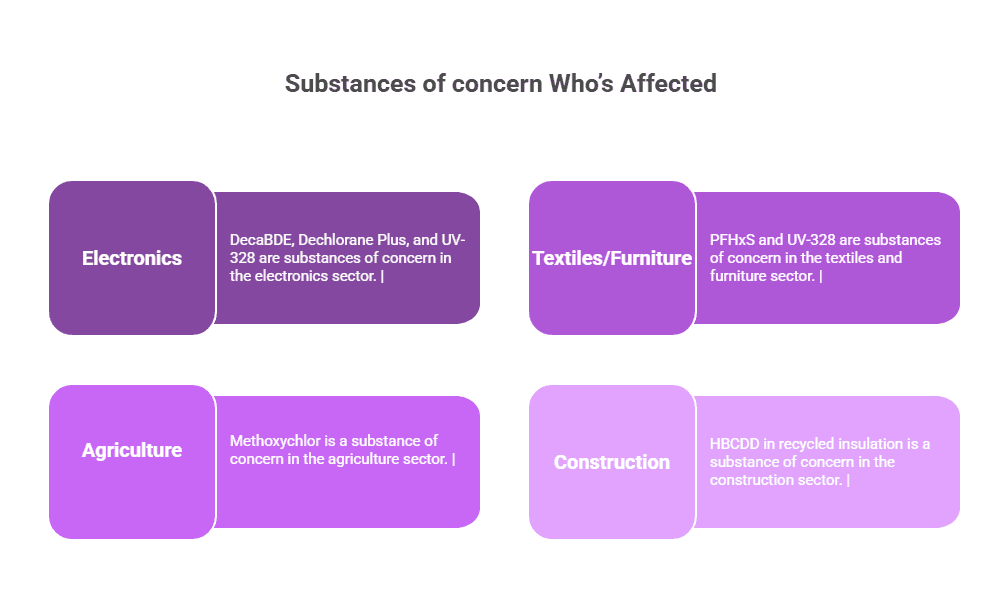
Who’s Affected?
How to Stay Compliant with Annex I & IV
- Screen products and BOMs against the latest Annex I listings
- Verify waste materials meet Annex IV thresholds
- Engage suppliers for full disclosure and safer substitutions
- Redesign products where phase-outs are unavoidable
- Maintain disposal documentation aligned with Annex V
Acquis POPs Compliance Program
At Acquis, we help manufacturers simplify EU POPs compliance with:
- Real-time BOM screening
- Annex IV waste-level checks
- Supplier declaration automation
- Lifecycle and phase-out tracking for POPs
Need help with UV-328, PFHxS, or Methoxychlor regulations? Contact us for a free compliance readiness assessment and stay ahead of EU enforcement.