






Table of Contents
- Why Prop 65 Disclosure Is a Supply Chain Problem First
- Understanding Your Prop 65 Disclosure Obligations
- Common Supply Chain Risks That Undermine Prop 65 Compliance
- Building a Prop 65 Supplier Declaration Process That Works
- Downstream Communication: How to Keep Retailers and Partners Informed
- How Acquis Helps You Take Control of Disclosure & Documentation
Why Prop 65 Disclosure Is a Supply Chain Problem First
You can’t manage what you can’t see and when it comes to Prop 65, visibility into your supply chain is everything. Electronics manufacturers often deal with hundreds of parts across dozens of suppliers, all with their own risk profiles.
But Prop 65 holds you accountable, not your suppliers.
If a product contains a listed substance and you fail to disclose it regardless of your supplier’s fault you’re on the hook for legal penalties and public exposure. This blog explains how to build a supply-chain-first approach to Prop 65 compliance, backed by validated data and clear downstream communication.
Understanding Your Prop 65 Disclosure Obligations
California’s Proposition 65 requires manufacturers to:
- Determine if a listed chemical is present in a product or component.
- Assess whether exposure could occur through foreseeable use.
- Provide a warning if exposure exceeds Safe Harbor levels or cannot be ruled out.
- Notify downstream entities (importers, distributors, retailers) about required warnings and responsibilities.
For B2B electronic product makers, the most critical steps are collecting data from upstream suppliers and communicating clearly downstream.
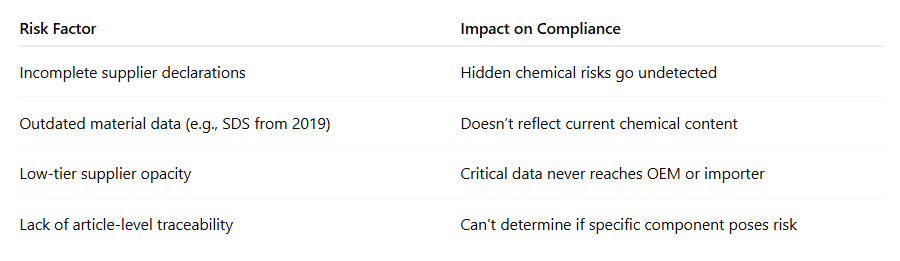
Common Supply Chain Risks That Undermine Prop 65 Compliance
Building a Prop 65 Supplier Declaration Process That Works
Here's a structured approach for electronics companies:
- Standardize Chemical Declaration Requests
- Use industry-accepted formats like IPC-1752A, IEC 62474, or full FMDs
- Include Proposition 65 chemical list as a mandatory disclosure field
- Tier-Based Outreach
- Start with Tier 1, then request data from Tier 2+ for high-risk parts
- Prioritize suppliers of components with adhesives, resins, plastics, coatings
- Validate and Cross-Check Data
- Use lab test reports or third-party audits to verify supplier claims
- Monitor for updates in Prop 65 list (updated 2x per year)
- Build a Central Documentation Hub
- Store all declarations, SDS, exposure assessments, and communication logs
- Ensure documents are accessible for internal teams and inspectors
Downstream Communication: How to Keep Retailers and Partners Informed
Under Prop 65, businesses must provide clear and timely warnings to retailers, e-commerce platforms, and end users. This includes:
- Providing warning labels for product packaging
- Including Prop 65 notifications in product spec sheets or safety documentation
- Notifying retailers in writing with warning language and placement requirements
If you're a private-label or component manufacturer, you may also be asked to certify that your product is Prop 65 compliant or provide a DoC (Declaration of Compliance).
How Acquis Helps You Take Control of Disclosure & Documentation
Acquis simplifies Prop 65 risk management by:
- Automating supplier outreach and chemical declaration collection
- Tracking changes to the Prop 65 chemical list
- Validating incoming data against regulatory thresholds
- Generating Prop 65 warning documentation and downstream reports
Whether you need to assess exposure, trace risk across articles, or notify channel partners—we’ve got you covered.