






Table of Contents
As consumers and regulatory bodies increasingly demand ethical sourcing and supply chain transparency, companies are under pressure to prove their products are conflict-free and compliant with global standards. At the core of these due diligence efforts lies the Reasonable Country of Origin Inquiry (RCOI) — a process designed to identify the origin of conflict minerals such as tin, tantalum, tungsten, and gold (3TG).
Used in industries from electronics to automotive, 3TG minerals are often sourced from conflict-affected and high-risk areas (CAHRAs), particularly the Democratic Republic of the Congo (DRC) and adjoining countries. Without rigorous due diligence, companies risk financing armed conflict and human rights abuses.
Why RCOI Matters
Conducting RCOI is a legal requirement for companies subject to Section 1502 of the Dodd-Frank Act and is the first step in filing Form SD with the U.S. Securities and Exchange Commission (SEC). Beyond compliance, RCOI:
- Supports ethical sourcing policies
- Reduces reputational and legal risks
- Builds a sustainable supply chain
- Aligns with OECD Due Diligence Guidance for Responsible Supply Chains of Minerals
- Prepares companies for EU Conflict Minerals Regulation 2017/821
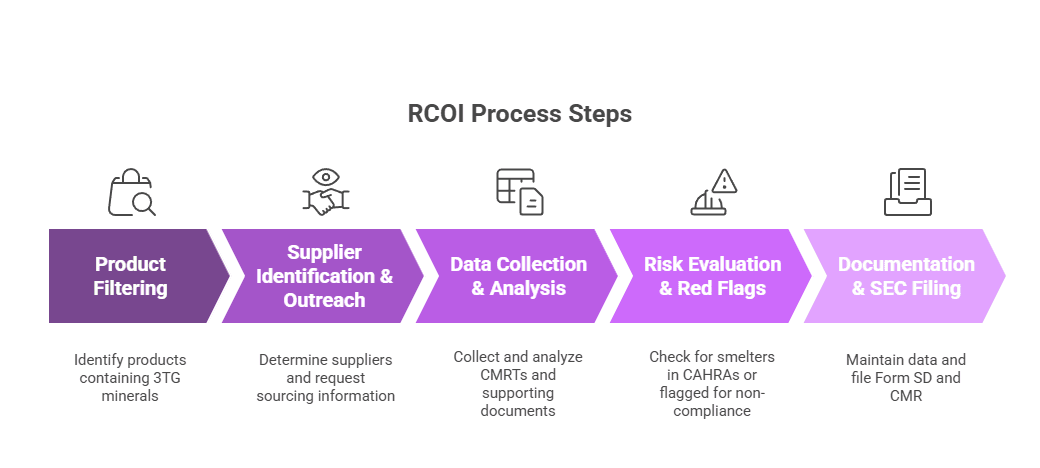
RCOI Process: Key Steps
1. Product Filtering Identify which of your products contain 3TG minerals and fall under the scope of RCOI. This helps define the boundary of your compliance reporting.
2. Supplier Identification & Outreach Determine which suppliers contribute to those products and request sourcing information. Use industry-standard tools like the Conflict Minerals Reporting Template (CMRT) to streamline this process.
3. Data Collection & Analysis Collect completed CMRTs and supporting documentation. Use software like Acquis to validate smelter data against industry-approved smelter lists (RMAP, RMI).
4. Risk Evaluation & Red Flags Check if smelters/refiners are in CAHRAs or flagged for non-compliance. If risks are found, initiate enhanced due diligence and document all actions taken.
5. Documentation & SEC Filing (Form SD) Maintain all data for at least 5 years. Prepare and file Form SD and, if necessary, a Conflict Minerals Report (CMR) by the May 31 annual deadline.
Common RCOI Challenges
- Low Supplier Response Rates
- Incomplete CMRTs
- Unvalidated Smelter Data
- Manual Follow-Ups and lack of automation
What Global Standards Require RCOI?
- U.S. Dodd-Frank Act (Section 1502) – For publicly listed companies
- OECD Due Diligence Guidance – Global best practice standard
- EU Regulation 2017/821 – Applies to EU-based importers of 3TG from CAHRAs
Emerging frameworks like the EU Corporate Sustainability Due Diligence Directive (CSDDD) and German Supply Chain Act (LkSG) are reinforcing RCOI as a global best practice, even for private companies.
RCOI vs. Due Diligence – What's the Difference?
- RCOI = Preliminary inquiry to determine if 3TG minerals originated in CAHRAs
- Due Diligence = In-depth follow-up if red flags are detected in the RCOI phase
How Acquis Simplifies RCOI
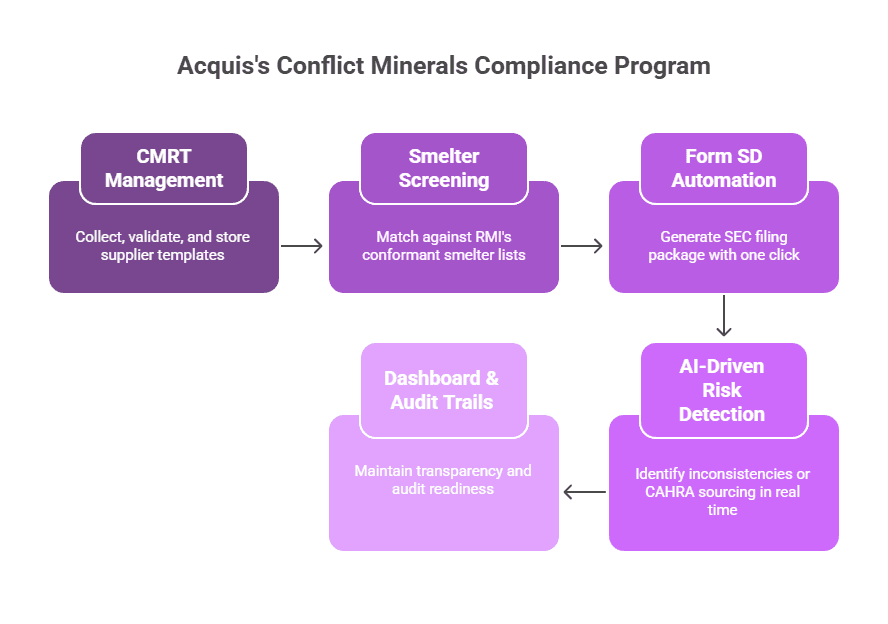
Acquis’s Conflict Minerals Compliance Program automates every stage of RCOI:
- CMRT Management: Collect, validate, and store all supplier templates
- Smelter Screening: Match against RMI’s conformant smelter lists
- Form SD Automation: Generate your SEC filing package with one click
- AI-Driven Risk Detection: Identify inconsistencies or CAHRA sourcing in real time
- Dashboard & Audit Trails: Maintain full transparency and readiness for audits
Strengthen your conflict minerals program today
RCOI is not just a regulatory requirement—it’s the cornerstone of ethical sourcing. With increasing scrutiny from investors, regulators, and consumers, companies must evolve from reactive compliance to proactive due diligence.
> Don’t treat RCOI like a checkbox. Use it to build transparency, resilience, and integrity into your supply chain.
Talk to Acquis compliance experts today and take the complexity out of RCOI.