






Table of Contents
- What Is ChemSHERPA? A Guide to Chemical Information Sharing and Material Declarations
- Why Material Declarations Matter in 2026 and Beyond
- What Is ChemSHERPA?
- Who Uses ChemSHERPA and Why?
- ChemSHERPA vs IPC-1752A: What’s the Difference?
- What Is a ChemSHERPA-CI File?
- ChemSHERPA-CI vs ChemSHERPA-AI
- Why ChemSHERPA Supports REACH and RoHS Compliance
- Challenges with ChemSHERPA (and How to Solve Them)
- Related Blogs
- ChemSHERPA and the Future of Supply Chain Transparency
- Final Thoughts: Is ChemSHERPA Worth It?
What Is ChemSHERPA? A Guide to Chemical Information Sharing and Material Declarations
Understand the format, its purpose, and how manufacturers use ChemSHERPA to meet REACH, RoHS, and global compliance requirements.
Why Material Declarations Matter in 2026 and Beyond
Today’s regulatory landscape demands more than basic compliance. Whether it’s REACH, RoHS, or PFAS restrictions, companies are being asked to prove what’s in their products substance by substance, component by component.
That’s where ChemSHERPA comes in.
What Is ChemSHERPA?
ChemSHERPA is a chemical information sharing scheme that enables companies to exchange standardized data on substances contained in products across supply chains. It originated in Japan and is maintained by JAMP (Joint Article Management Promotion Consortium).
- It enables full material disclosure (FMD)
- Used by manufacturers, OEMs, and suppliers
- Supports compliance with regulations like REACH, RoHS, and CSCL
> ChemSHERPA helps you collect, verify, and transmit material-level data—so you’re not just compliant, you're transparent.
Who Uses ChemSHERPA and Why?
ChemSHERPA is widely adopted in:
- Electronics
- Automotive
- Electrical equipment
- Industrial components
- Consumer goods
In practice, ChemSHERPA information flows upstream through the supply chain, where component suppliers provide substance data to manufacturers, who then consolidate this information to meet regulatory reporting obligations and customer disclosure requirements.
Why? Because companies in these industries must prove that their products don’t contain substances banned or restricted under:
ChemSHERPA vs IPC-1752A: What’s the Difference?
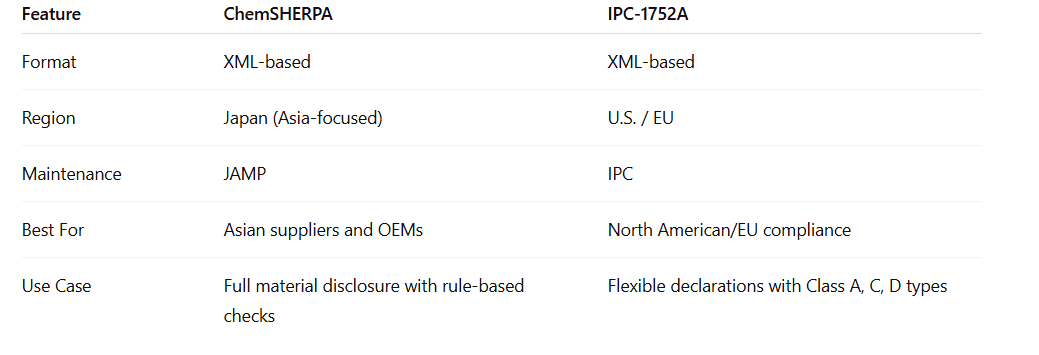
Verdict: Use ChemSHERPA if you work with Japanese or Asian suppliers, or if your clients demand it. IPC-1752A may be better for global flexibility, but ChemSHERPA is stricter and more standardized.
What Is a ChemSHERPA-CI File?
The CI stands for Component Information. A ChemSHERPA-CI file includes:
- Product ID, supplier details
- Full list of materials
- Substance composition
- Regulatory flags (REACH SVHC, RoHS)
- Unit weight per component
It's an XML file format that integrates into product compliance software and digital product passport (DPP) initiatives.
ChemSHERPA-CI vs ChemSHERPA-AI
ChemSHERPA provides two main data formats:
- chemSHERPA-CI (Chemical Information): Used for substances and mixtures.
- chemSHERPA-AI (Article Information): Used to communicate substance data in articles and components across supply chains.
Both formats enable standardized information exchange between suppliers and manufacturers.
Why ChemSHERPA Supports REACH and RoHS Compliance
ChemSHERPA is built to align with global substance restrictions. Here’s how:
- REACH SVHCs: Flag any substance >0.1% w/w per articles.
- RoHS: Check material data against 0.1% thresholds for Pb, Hg, Cd, etc.
- Export controls: Optional fields support Japan CSCL and other Asian regulations
No more chasing spreadsheets. With ChemSHERPA, your FMD data is structured, validated, and traceable.
Challenges with ChemSHERPA (and How to Solve Them)
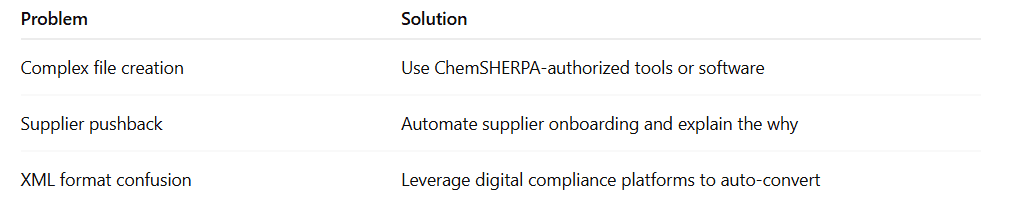
> Tip: Platforms like Acquis Compliance simplify ChemSHERPA-CI creation and supplier data collection—without manual file wrangling.
Related Blogs
- Full Material Disclosure (FMD) Software
- REACH SVHC Compliance Guide
- RoHS Compliance Checklist
- Digital Product Passport Strategy
ChemSHERPA and the Future of Supply Chain Transparency
As regulations increasingly require detailed product data, structured substance information systems like ChemSHERPA are becoming more important.
Standardized declaration frameworks help companies prepare for emerging regulatory requirements such as:
- digital product traceability initiatives
- expanded chemical disclosure requirements
- supply chain sustainability reporting
By structuring substance data early, companies can reduce future compliance burdens and improve supply chain transparency.
Final Thoughts: Is ChemSHERPA Worth It?
Yes—if your clients demand FMD, or you’re dealing with complex multi-tier supply chains. ChemSHERPA offers:
- Greater transparency
- Better data structure
- Easier compliance with global regulations
If your teams are still relying on outdated declarations or spreadsheets, this is your signal to modernize.