






Table of Contents
As global supply chains grow more complex and regulatory pressure on responsible sourcing intensifies, companies must track the origins of minerals used in their products. Whether it’s to comply with mandatory regulations like the U.S. Dodd-Frank Act or to meet voluntary ESG and investor expectations, standardized tools such as CMRT, EMRT, and AMRT are now essential components of mineral due-diligence programs.
Let’s explore the key differences between these three reporting templates—Conflict Minerals Reporting Template (CMRT), Extended Minerals Reporting Template (EMRT), and Additional Minerals Reporting Template (AMRT)—and how they work together to support compliant, future-ready sourcing strategies.
What Is the CMRT?
The Conflict Minerals Reporting Template (CMRT) is the original standardized reporting tool created by the Responsible Minerals Initiative (RMI) to support supply-chain due diligence on the sourcing of 3TG minerals:
- Tin
- Tantalum
- Tungsten
- Gold
These minerals have historically been linked to financing armed conflict and human-rights abuses in the Democratic Republic of the Congo (DRC) and adjoining countries. Companies subject to Section 1502 of the U.S. Dodd-Frank Act or the EU Conflict Minerals Regulation rely on CMRT to collect supplier data, identify smelters and refiners, and determine countries of origin.
Key Details of CMRT
- Latest Version: CMRT 6.5 (released April 25, 2025)
- Regulatory Use: Mandatory for SEC filers and EU importers of 3TG
- Structure: Supplier engagement, smelter/refiner lists, country-of-origin data, and company policy declarations
CMRT remains the foundational compliance tool for conflict-minerals regulation globally.
What Is the EMRT?
The Extended Minerals Reporting Template (EMRT) was introduced to expand mineral due diligence beyond 3TG into minerals associated with ESG, battery supply chains, and emerging regulation.
EMRT currently covers:
- Cobalt
- Mica
- Copper
- Lithium
- Nickel
- Natural Graphite
(Expanded mineral scope introduced in EMRT 2.0)
EMRT aligns with OECD Due Diligence Guidance and supports voluntary but increasingly expected reporting—particularly in connection with the EU Battery Regulation and broader EU Green Deal objectives.
Key Details of EMRT
- Latest Version: EMRT 2.0 (released April 25, 2025)
- Regulatory Use: Voluntary, ESG-driven; increasingly relied upon for battery and sustainability disclosures
- Structure: Supplier declarations, smelter/refiner identification, and optional mine-level origin data
EMRT is now widely treated as the authoritative template for cobalt and mica due diligence.
What Is the AMRT?
The Additional Minerals Reporting Template (AMRT)—formerly known as the Pilot Reporting Template (PRT)—is RMI’s most flexible reporting tool. It enables companies to track up to 10 user-selected minerals per AMRT submission that fall outside the scope of CMRT and EMRT.
AMRT is designed to support early-stage risk identification for minerals that may be:
- Flagged as critical raw materials by the EU or U.S.
- Subject to NGO or customer scrutiny
- Relevant to specific sectors or technologies
Examples include rare earth elements and other strategically important or emerging-risk materials.
Key Details of AMRT
- Latest Version: AMRT 1.3 (released October 17, 2025)
- Regulatory Use: Voluntary; insight-driven due-diligence and risk screening
- Structure: Fully configurable; companies define which minerals to report and what data to collect
While AMRT is not mandated by regulation, it is increasingly used to evidence proactive supply-chain risk management.
Read the Conflict Minerals eBook: avoid CMRT/EMRT/AMRT audit failures.
Comparison: CMRT vs EMRT vs AMRT
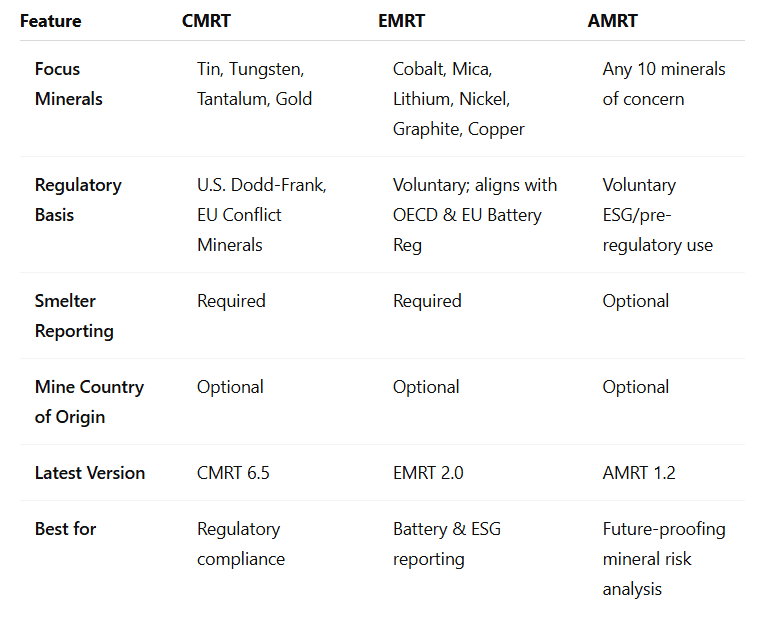
Why These Templates Matter
Regulators, investors, customers, and civil-society organizations increasingly expect companies to demonstrate traceability, transparency, and risk awareness across mineral supply chains.
Using CMRT, EMRT, and AMRT together helps organizations achieve:
- Stronger supplier engagement and risk identification
- Consistent, audit-ready documentation
- Improved ESG credibility with stakeholders
- Readiness for expanding regulatory coverage
Relying solely on mandatory reporting is no longer sufficient for long-term compliance resilience.
How Acquis Supports Responsible Minerals Reporting
From supplier outreach and validation to reporting automation, Acquis Compliance helps companies operationalize mineral due diligence at scale.
- Download the latest CMRT & EMRT templates
- Book a demo to see how Acquis supports CMRT, EMRT, and AMRT workflows end-to-end
CMRT. EMRT. AMRT. Different scopes—one goal: transparent, ethical sourcing.
Last updated: January 2026 (aligned with CMRT 6.5, EMRT 2.0, and AMRT 1.3).