






Table of Contents
- What Is a Digital Product Passport (DPP)?
- Who Needs to Comply — And When?
- Your FMD Readiness Checklist for DPP
- 1. Do You Have Full Disclosure Data?
- 2. Are You Flagging Regulated Substances?
- 3. Is Your Data Digitally Structured?
- 4. Can You Prove Documentation?
- 5. Are Your Suppliers FMD-Capable?
- 6. Are You Ready to Scale & Maintain?
- What About Circularity & Carbon?
- Why Acquis?
- Final Word: DPP Is Inevitable. Non-Compliance Isn’t Optional.
This isn’t a “someday” regulation.
The Digital Product Passport (DPP) is live, mandated under the Ecodesign for Sustainable Products Regulation (ESPR) and it’s reshaping how manufacturers manage product data, materials, and supply chains in the EU.
Driven by the EU Green Deal, Circular Economy Action Plan, and new delegated product rules, the DPP will become the standard compliance format across Europe.
And at the heart of it?
Full Material Disclosure (FMD).
What Is a Digital Product Passport (DPP)?
It’s exactly what it sounds like: a digital identity for every product, embedded with structured, supply-chain-wide data.
Each DPP includes:
- What the product is made of (material breakdown)
- How it was manufactured
- Whether it contains hazardous substances (REACH, RoHS, POPs, TSCA)
- How to recycle, reuse, or safely dispose of it
- (Coming soon) Carbon footprint data using ISO 14067
It’s machine-readable (XML, RDF), linked to a QR code or NFC tag, and accessible across the EU’s central digital registry (under development).
If you're not prepared, the penalties aren’t abstract:
- Delayed customs clearance
- Rejected shipments
- Loss of EU market access
Who Needs to Comply — And When?
The Ecodesign Regulation (EU) 2024/1781 2024/1781) applies across sectors, but DPP rollout is product-specific via Delegated Acts:
- Batteries → Already mandatory under EU Battery Regulation 2023/1542
- Textiles, Electronics, Construction → Implementation by 2025–2027
- All high-impact products → Covered eventually
You won’t get a grace period. You’ll need to prove:
- FMD with substance-level breakdown
- Regulated substance flagging (SVHC, RoHS, POPs, TSCA)
- Circularity metrics (repairability, recyclability, carbon footprint)
- Standardized formats (IPC 1752A, IEC 62474, FMD XML)
Your FMD Readiness Checklist for DPP
Let’s cut through the fluff. If your Full Material Disclosure (FMD) program doesn’t pass these six questions, you're not DPP-ready.
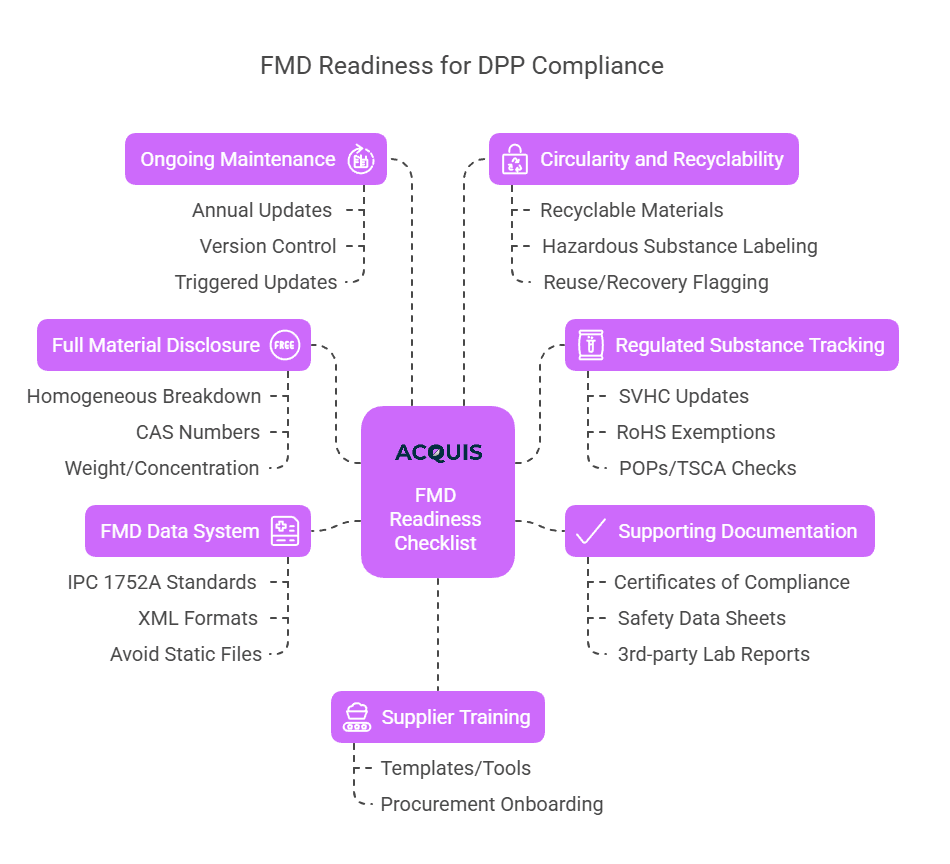
1. Do You Have Full Disclosure Data?
- Homogeneous material-level breakdown?
- CAS numbers for each substance?
- Weight, PPM, or concentration for every part?
2. Are You Flagging Regulated Substances?
- REACH SVHCs (updated every 6 months)?
- RoHS 10 substances with exemption handling?
- POPs and TSCA checks embedded?
3. Is Your Data Digitally Structured?
- Standards: IPC 1752A, IEC 62474, FMD XML?
- Machine-readable formats (XML/RDF)?
- NO Excel, PDF, or screenshots as final source?
4. Can You Prove Documentation?
- Certificates of Compliance (CoC)?
- Safety Data Sheets (SDS)?
- 3rd-party test reports? Exemption evidence?
5. Are Your Suppliers FMD-Capable?
- Do they understand FMD requirements?
- Do you onboard them with templates & tools?
- Is FMD baked into your procurement contracts?
6. Are You Ready to Scale & Maintain?
- Semi-annual updates for new SVHCs?
- Version control system in place?
- Triggered updates for any part change?
What About Circularity & Carbon?
By 2026–27, most product DPPs will require:
- Recyclability assessments
- Hazardous content identification
- Product Carbon Footprint (PCF) ISO 14067 or PACT-aligned
If you’re not mapping material flow or carbon yet, you’re already behind.
Why Acquis?
Because compliance isn’t a static checkbox anymore. It’s a live data ecosystem.
The Acquis Compliance Platform enables:
- Campaign-driven FMD collection at scale
- Real-time SVHC/RoHS/POPs validation
- XML/FMD-ready data generation for DPP submission
- Circularity scoring & supply chain traceability
We don’t just digitize compliance, we automate it.
Final Word: DPP Is Inevitable. Non-Compliance Isn’t Optional.
Every delay in FMD readiness = risk to your EU market access.
Let competitors scramble. You get ahead.
Start building the digital backbone today.
Need help getting your FMDs DPP-ready?
Book a demo with Acquis and see how fast we can operationalize your DPP compliance program.