






Table of Contents
- Beyond Conflict Minerals: Why EMRT Matters for Ethical Cobalt and Mica Sourcing
- What Is EMRT — and Why It Exists
- Why Cobalt and Mica Are High-Risk Minerals
- Cobalt: Critical, Concentrated, Scrutinized
- Mica: Ubiquitous and Under-Reported
- EMRT vs CMRT: Understanding the Difference
- Who EMRT Is For
- How EMRT Works in Practice
- Identifying and Managing Risk with EMRT
- Disclosure and Transparency
- What EMRT Does Not Replace
- EMRT in 2026: Voluntary in Name, Required in Practice
- Final Takeaway
Beyond Conflict Minerals: Why EMRT Matters for Ethical Cobalt and Mica Sourcing
For years, conflict minerals compliance revolved around one question: Are you reporting on 3TG correctly? Today, that question is no longer enough.
Cobalt and mica—critical to batteries, electronics, automotive components, paints, and cosmetics—have become the next major fault line in supply-chain due diligence. Regulators may not name EMRT explicitly in law, but buyers, auditors, and ESG frameworks increasingly expect the same thing: structured, defensible visibility beyond conflict minerals.
That’s where the Extended Minerals Reporting Template (EMRT) comes in.
What Is EMRT — and Why It Exists
The Extended Minerals Reporting Template (EMRT) was developed by the Responsible Minerals Initiative (RMI) to help downstream companies systematically collect and disclose information on cobalt and mica sourcing.
EMRT is designed to operationalize the 5-step framework of the OECD Due Diligence Guidance, translating abstract expectations into a practical, auditable data-collection process.
Formally, EMRT is voluntary. In practice, in 2026, it is baseline evidence for companies supplying into regulated markets or global OEMs.
Why Cobalt and Mica Are High-Risk Minerals
Cobalt: Critical, Concentrated, Scrutinized
Cobalt is essential for lithium-ion batteries, superalloys, and advanced electronics. Around 70% of global cobalt mine supply originates from the Democratic Republic of Congo (DRC).
The core risks regulators and buyers focus on today are:
- child labor in artisanal and small-scale mining (ASM),
- unsafe and informal working conditions,
- weak oversight and subcontracting opacity.
Risk is not uniform across all cobalt mining, but without structured due diligence, companies struggle to distinguish responsible sourcing from high-risk exposure.
Mica: Ubiquitous and Under-Reported
Mica is used in:
- automotive components,
- electronics and insulation,
- paints and coatings,
- cosmetics and personal care products.
It is mined in 35+ countries, with India and Madagascar consistently identified as high-risk regions due to informal mining, child labor, and unsafe conditions—particularly affecting women and children.
Despite its widespread use, mica often sits below the visibility threshold of traditional compliance programs. EMRT is designed to close that gap.
EMRT vs CMRT: Understanding the Difference
Many companies still conflate EMRT with the Conflict Minerals Reporting Template (CMRT). They are related—but not interchangeable.
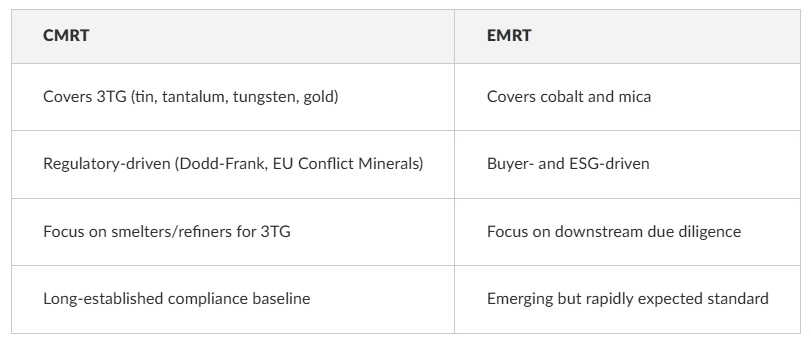
EMRT does not replace CMRT. Companies sourcing both 3TG and cobalt/mica are expected to use both templates.
Who EMRT Is For
EMRT is designed for downstream companies—from brand owners and OEMs through tier-1 and tier-2 manufacturers, excluding refiners and processors themselves.
If you:
- place products on the EU or US market,
- supply to global OEMs,
- publish ESG or sustainability disclosures,
- operate under human-rights due-diligence laws,
You are already in EMRT territory—whether it’s called that explicitly or not.
How EMRT Works in Practice
EMRT uses a standardized questionnaire that downstream companies cascade through their supply chains to answer four critical questions:
- Is cobalt or mica present in products or production processes?
- Where does it come from? (country of origin)
- Which refiners or processors are involved?
- Does sourcing involve CAHRAs (Conflict-Affected and High-Risk Areas) or recycled/scrap material?
A key strength of EMRT is that it includes RMI-maintained lists of identified cobalt refiners and mica processors (including aliases). This allows companies to validate supplier responses instead of relying on unchecked declarations.
Identifying and Managing Risk with EMRT
Using EMRT responses, companies can:
- map exposure to high-risk geographies,
- identify unknown or unverified refiners/processors,
- Prioritize suppliers for deeper engagement or corrective action.
RMI supports this process through its Responsible Minerals Assurance Process (RMAP).
Important distinction: RMAP conformance means a facility has been audited against RMI protocols at a point in time. It does not mean risk-free sourcing. Ongoing monitoring remains the company’s responsibility—an expectation auditors increasingly test.
Disclosure and Transparency
Once EMRT data is consolidated, companies use it to:
- respond to customer due-diligence requests,
- support ESG and sustainability reporting,
- demonstrate human-rights risk management,
- increase transparency with upstream and downstream partners.
EMRT has become a common language between buyers and suppliers—especially where legal requirements stop short of prescriptive reporting formats.
What EMRT Does Not Replace
A credible compliance program is clear about boundaries.
EMRT does not replace:
- site-level audits,
- worker interviews,
- grievance mechanisms,
- corrective action plans,
- on-the-ground monitoring initiatives.
Instead, EMRT provides the structured data foundation that tells companies where deeper action is required.
EMRT in 2026: Voluntary in Name, Required in Practice
Even without a single “EMRT law,” expectations have shifted:
- OEMs increasingly require EMRT contractually
- ESG and human-rights disclosures demand supplier-level evidence
- Auditors expect standardized, comparable data
- Informal spreadsheets and PDFs no longer hold up
For cobalt and mica, EMRT is fast becoming the baseline proof of due diligence.
Final Takeaway
Conflict minerals compliance was the first chapter. Cobalt and mica are the next.
EMRT gives companies a defensible, auditable, and scalable way to understand where risk enters their supply chains—and to prove they are managing it responsibly.
In modern compliance, intent is no longer enough. Visibility wins. Every time.