






FLUKE
Kimball Electronics
Tolomatic
Industrial Scientific
AHEAD
roboception
FLUKE
Kimball Electronics
Tolomatic
Industrial Scientific
AHEAD
roboception
By Abhishek Shetty | Tue Jul 1 2025 | 2 min read

If you’re a compliance manager juggling multiple EU regulations, you’ve probably asked this before:

> “Aren’t POPs already covered under REACH?” > “Do I need to track the same substances twice?”

The short answer? No—and yes.

Let’s break down the critical differences between the EU POPs Regulation (EU) 2019/1021 and the REACH Regulation (EC) No 1907/2006—and why ignoring the nuance could expose your business to regulatory risk.

What Is the EU POPs Regulation?

The Persistent Organic Pollutants (POPs) Regulation is laser-focused on one thing: long-lived, bioaccumulative, and toxic chemicals that travel globally and build up in ecosystems and humans.

It enforces the EU’s commitment to the Stockholm Convention—a global treaty on banning/restricting POPs.

Key obligations under EU POPs:

  • Prohibit manufacture, use, and placing on the market of listed POPs (Annex I)
  • Mandate waste destruction above thresholds Annex IV.
  • Align with international bans and controls

POPs are regulated whether they are:

  • Intentionally used (e.g., flame retardants in electronics)
  • Unintentionally generated (e.g., industrial by-products like dioxins)

What Is REACH?

The REACH Regulation is the EU’s all-encompassing chemical safety framework. It stands for:

> Registration, Evaluation, Authorisation, and Restriction of Chemicals

REACH is about risk management at scale—covering all chemicals, not just POPs. That includes:

  • Industrial chemicals
  • Additives
  • Intermediates
  • Substances in articles

It enforces:

POPs vs. REACH – Key Differences at a Glance
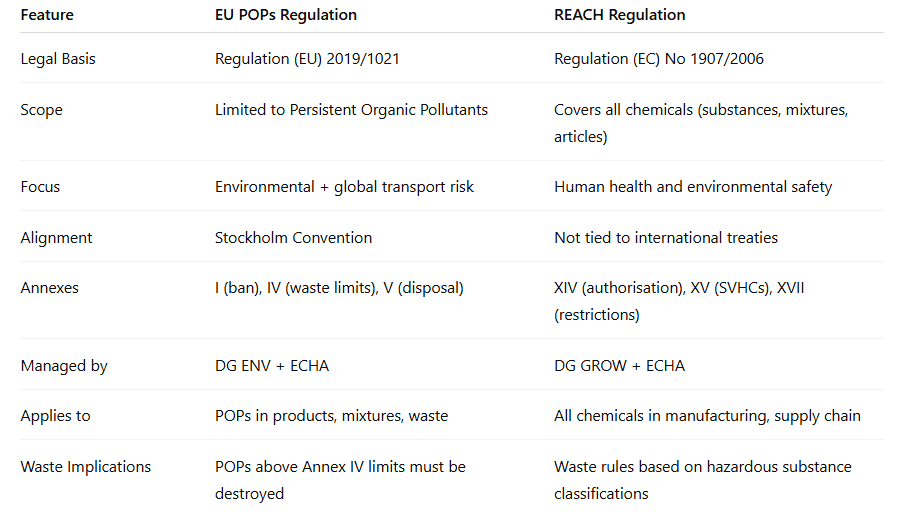
POPs vs. REACH – Key Differences at a Glance.PNG

Understanding the difference between POPs and REACH is easier when supported by a centralized REACH compliance management system across the supply chain.

Why This Matters for Manufacturers

If you manufacture, import, or sell products in the EU—especially electronics, textiles, or machinery—you may be subject to both regulations for the same chemical.

Example 1: DecaBDE (a flame retardant)

  • Listed in POPs Annex I (banned above 10 mg/kg)
  • Also restricted under REACH Annex XVII → Must comply with both product and waste rules.

Example 2: PFHxS

  • Added to POPs Annex I (2023)
  • Likely to trigger scrutiny under REACH SVHC Candidate List in the future → Dual tracking required.

Do POPs and REACH Overlap?

Yes, but the difference lies in purpose and consequence.

  • POPs is about elimination → You cannot use or place on market above UTC thresholds.
  • REACH is about risk management → You might be allowed to use the chemical but must justify and communicate risk.

Think of POPs as “absolute bans” and REACH as “regulated use with obligations.”

Keeping Track of Amendments

The EU updates POPs and REACH independently. Here’s how:

  • POPs: Based on decisions from the Stockholm Convention (UN-level), often followed by ECHA’s proposal and Commission amendments.
  • REACH: SVHCs can be added anytime through Annex XV dossiers submitted by Member States or ECHA.

Recent POPs Additions (2023–2025):

  • PFHxS and related compounds
  • Methoxychlor
  • UV-328
  • Dechlorane Plus

Recent REACH SVHC Updates (June 2025):

  • 1,1,1,3,5,5,5-heptamethyl-3-\[(trimethylsilyl)oxy]trisiloxane
  • Textile dyes and cosmetics ingredients flagged as vPvB

Compliance Best Practices

  1. Screen for both REACH and POPs lists → Use tools that support dual compliance.
  2. Track updates regularlyCandidate List (SVHC) for REACH, Annex I for POPs.
  3. Engage suppliers → Get material declarations that cover both regulatory scopes.
  4. Verify waste streams → Ensure Annex IV POPs thresholds are not exceeded for reuse or landfill.
  5. Redesign products if needed → Some POPs allow no substitutes—plan ahead.

Acquis Helps You Manage REACH + POPs in One Platform

At Acquis, we simplify multi-regulation compliance with:

  • Unified substance screening across POPs, REACH, RoHS, and more
  • BOM-level mapping and UTC verification
  • Real-time alerts for Annex changes
  • Supply chain engagement for full declarations

Book your free REACH + POPs compliance assessment now

Topics

Speak to Our Compliance Experts

Questions about compliance, partnerships, or support? We're here to help.

Share

EU POPs Regulation vs. REACH Regulation

The EU POPs Regulation (Regulation (EU) 2019/1021) specifically targets Persistent Organic Pollutants (POPs), chemicals that are persistent, bioaccumulative, and toxic. It enforces strict bans and unintentional trace contaminant (UTC) thresholds in line with the Stockholm Convention . In contrast, the REACH Regulation (EC No 1907/2006) governs the safe use of all chemicals within the EU, including registration, SVHC tracking, authorisation, and restriction. REACH is broader, but POPs is stricter and globally aligned.
Yes, companies placing products on the EU market—especially in the electronics, textiles, and automotive sectors—must comply with both REACH and EU POPs . For example, DecaBDE and PFHxS are banned under POPs and simultaneously restricted under REACH. Failure to meet obligations under either regulation can result in supply chain disruptions, market withdrawal, or penalties.
Several substances are dual-listed, requiring businesses to meet the strictest standard. These include: DecaBDE (Decabromodiphenyl ether) PFHxS and its salts/related compounds UV-328 HBCDD (Hexabromocyclododecane) These chemicals appear in Annex I of EU POPs and also in REACH Annex XVII %20covered) or the Candidate List of SVHCs , triggering multiple compliance obligations.
If a substance is listed in Annex I of the EU POPs Regulation , it is banned from being manufactured, used, or placed on the EU market above specific trace contaminant thresholds. For example, Methoxychlor is allowed only up to 0.01 mg/kg, while PFHxS has a threshold of 0.025 mg/kg. This goes beyond REACH, where restricted substances might still be used with authorisation or under defined limits.
Under EU POPs Annex IV , any waste exceeding defined mg/kg thresholds (e.g., PFHxS at 0.025 mg/kg, UV-328 at 1–100 mg/kg depending on phase) must be destroyed using Annex V methods and cannot be recycled. REACH does not define waste treatment thresholds—it primarily governs the safe use of substances in products and articles.
REACH SVHC Candidate List is updated roughly twice a year by ECHA (e.g., June 2025: 1,1,1,3,5,5,5-heptamethyl-3- [ (trimethylsilyl)oxy]trisiloxane). EU POPs Regulation Annex I and IV are updated based on global treaties like the Stockholm Convention, typically once or twice annually. Manufacturers must monitor ECHA updates, Official Journal of the EU, and Member State proposals to stay compliant.
To ensure full regulatory coverage, manufacturers should: Map chemicals across REACH SVHC, REACH Annex XVII, and EU POPs Annex I Screen BOMs for trace levels (mg/kg) using compliance software Engage suppliers for full declarations including POPs threshold data Set alerts for new substance additions and update technical documentation Verify waste thresholds under POPs Annex IV for production and end-of-life management
SVHCs under REACH (Candidate List) indicate concern but can still be used under certain conditions, triggering obligations like communication (Article 33) or registration. Substances in POPs Annex I , however, are prohibited above trace levels and generally cannot be used unless exemptions apply. Think of REACH SVHC as a “watchlist” and POPs Annex I as a “blacklist.”
Yes. The Acquis Compliance Platform for REACH and POPs provides: Dual screening for REACH + POPs substances Automated threshold checks (SVHC %, POPs mg/kg) Supplier engagement workflows for full material disclosure Annex IV waste limit validation Regulatory update alerts for all POPs and REACH changes This enables electronics and industrial manufacturers to ensure full chemical compliance, reduce risk, and accelerate audits.