






Table of Contents
- What is RoHS?
- What is REACH?
- REACH vs. RoHS: Key Differences
- Restricted Substances Under REACH & RoHS
- REACH: Comprehensive Chemical Restrictions
- RoHS: Targeted Substances in Electronics
- How to Ensure Compliance with REACH & RoHS
- REACH Compliance Steps:
- RoHS Compliance Steps:
- REACH + RoHS Compliance Checklist
- REACH vs. RoHS Enforcement: What Happens if You Don’t Comply?
- Beyond the EU: How REACH & RoHS Affect Global Markets
- Conclusion: How to Stay Compliant
- Get Expert Help with REACH & RoHS Compliance
In today’s world, environmental concerns have led governments and international bodies to establish stringent regulations aimed at protecting human health and the environment. Two of the most critical regulations in this domain are RoHS (Restriction of Hazardous Substances) and REACH (Registration, Evaluation, Authorization, and Restriction of Chemicals).
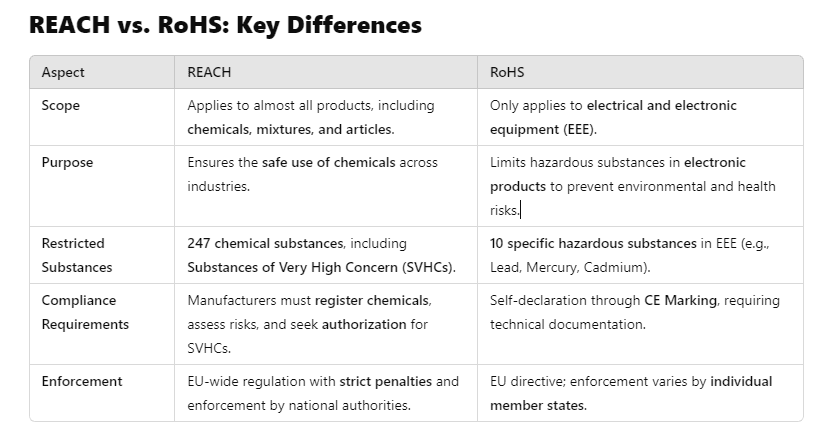
Although these regulations share a common goal of promoting safer and more sustainable manufacturing, they differ significantly in their scope, compliance requirements, and enforcement.
What is RoHS?
The Restriction of Hazardous Substances (RoHS) directive was introduced to address concerns about hazardous materials used in electrical and electronic equipment (EEE). Enforced within the European Union (EU) and adopted by several other countries, RoHS aims to limit ten hazardous substances found in electronics that pose risks to human health and the environment.
What is REACH?
The Registration, Evaluation, Authorization, and Restriction of Chemicals (REACH) regulation is an extensive EU regulation designed to manage chemical substances across all industries. REACH regulates the production, import, and use of chemicals, requiring manufacturers and suppliers to register, evaluate, and, in some cases, obtain authorization for substances that may pose serious risks to health or the environment.
REACH vs. RoHS: Key Differences
Restricted Substances Under REACH & RoHS
REACH: Comprehensive Chemical Restrictions
REACH currently regulates 247 hazardous substances as of January 2025, regardless of whether they are used on their own, in mixtures, or as components of finished products. The list is updated regularly by the European Chemicals Agency (ECHA) and includes substances that may cause cancer, genetic mutations, or reproductive harm.
Understanding where RoHS ends and REACH begins is easier when both are supported through a consistent REACH compliance management framework.
RoHS: Targeted Substances in Electronics
- Cadmium (Cd): < 100 ppm
- Lead (Pb): < 1000 ppm
- Mercury (Hg): < 1000 ppm
- Hexavalent Chromium (Cr VI): < 1000 ppm
- Polybrominated Biphenyls (PBB): < 1000 ppm
- Polybrominated Diphenyl Ethers (PBDE): < 1000 ppm
- Bis(2-Ethylhexyl) phthalate (DEHP): < 1000 ppm
- Benzyl butyl phthalate (BBP): < 1000 ppm
- Dibutyl phthalate (DBP): < 1000 ppm
- Diisobutyl phthalate (DIBP): < 1000 ppm
There are exemptions for certain applications listed in Annexes III & IV of the RoHS directive, but manufacturers must disclose exemptions in compliance declarations.
How to Ensure Compliance with REACH & RoHS
REACH Compliance Steps:
- Register substances with ECHA if your company manufactures or imports more than one ton of a substance per year.
- Evaluate risks associated with substances and submit a Chemical Safety Assessment (CSA).
- Apply for authorization if substances fall under the Substances of Very High Concern (SVHCs) list.
- Ensure supply chain transparency by communicating safety information downstream.
RoHS Compliance Steps:
- Test and verify that products comply with RoHS-restricted substance limits.
- Compile a Technical File, which must include test reports and supplier declarations.
- Self-declare compliance by applying CE Marking to compliant products.
- Maintain documentation for at least 10 years after placing the product on the market.
REACH + RoHS Compliance Checklist
- REACH Compliance Checklist
- Identify substances in BOM >0.1% SVHC threshold
- Notify customers (Art. 33)
- Register substances (if >1t/year)
- Submit SCIP dossiers if needed
- Apply for authorization if SVHC is in Annex XIV
- RoHS Compliance Checklist
- Lab test for 10 restricted substances
- Collect supplier declarations
- Maintain CE Declaration of Conformity
- Compile Technical Documentation
- Retain files for 10 years post-market
REACH vs. RoHS Enforcement: What Happens if You Don’t Comply?

Beyond the EU: How REACH & RoHS Affect Global Markets
Many other countries have adopted similar regulations to protect consumers and the environment. Examples include:
- China RoHS – Similar to EU RoHS but with different implementation rules.
- US TSCA (Toxic Substances Control Act) – Regulates chemical substances in the U.S.
- UK REACH – A post-Brexit version of EU REACH with separate compliance processes.
Manufacturers operating internationally must align compliance strategies across multiple regulatory frameworks to ensure continued market access.
Conclusion: How to Stay Compliant
Understanding the differences between REACH and RoHS is critical for businesses manufacturing or importing products into the EU. Ensuring compliance requires careful monitoring of regulations, proper documentation, and a proactive approach to supply chain management.
Get Expert Help with REACH & RoHS Compliance
✅ Download The Complete Guide to EU REACH Regulation (https://www.acquiscompliance.com/ebook/eu-reach-regulation-compliance-guide/) ✅ Download The Complete Guide to ROHS Compliance ✅ Request a Demo – See how our REACH & RoHS compliance solutions simplify data collection and supplier validation.