






Table of Contents
- Here’s how to build Full Material Disclosures Data that actually works.
- Step 1: Understand Why Suppliers Push Back
- Step 2: Start with the Right Suppliers
- Step 3: Equip Them with Tools and Templates
- Step 4: Build FMD into Your Procurement Process
- Step 5: Communicate the “Why”
- Step 6: Follow Up and Celebrate the Wins
Let’s not sugarcoat it:
Collecting Full Material Disclosures (FMDs) is 50% data management...
and 50% supplier wrangling.
If you’ve ever sent 10 emails to the same supplier and gotten back a blurry PDF with the wrong part number you already know. The best tools in the world won’t help if your suppliers don’t deliver the data.
That’s why you need a supplier engagement strategy not just a spreadsheet and good intentions.
Here’s how to build Full Material Disclosures Data that actually works.
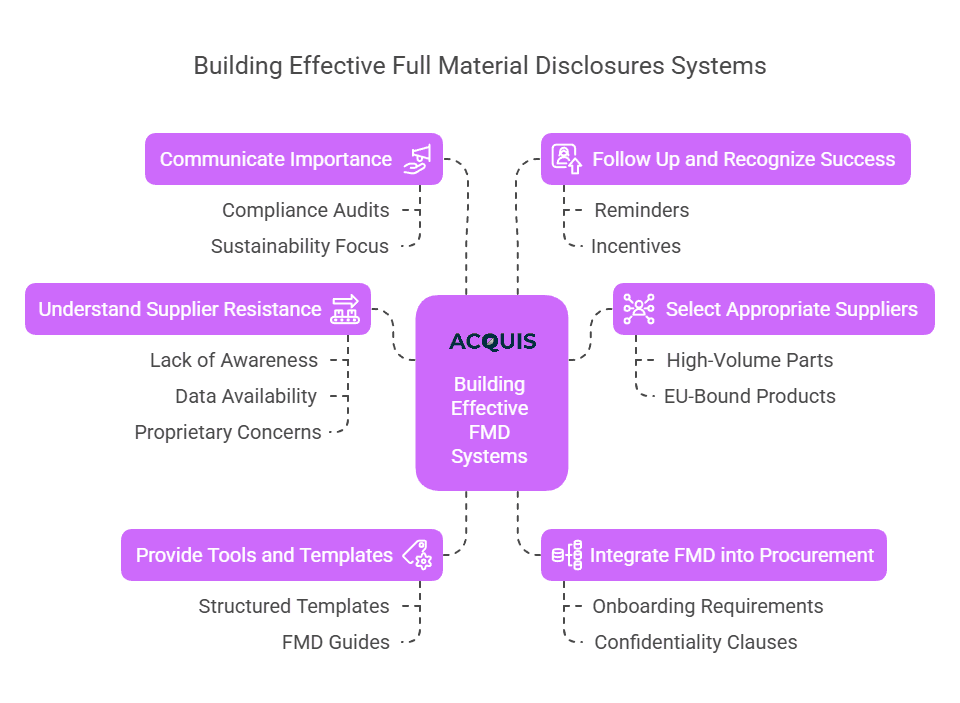
Step 1: Understand Why Suppliers Push Back
Before you fix it, understand the friction. Here’s why most suppliers don’t hand over FMD data easily:
- They don’t know what FMD is
- They don’t have the data readily available
- They’re afraid of exposing proprietary info
- They think declarations are “good enough”
- No one’s ever asked them before
And honestly? Most are already drowning in customer requests.
Your job is to make it easier to say yes.
Step 2: Start with the Right Suppliers
Don’t try to boil the ocean. Begin with:
- High-volume parts
- EU-bound products
- Suppliers with known risk (e.g., electronics, coatings, adhesives)
- Suppliers already providing CoCs or regulatory declarations And focus on off-the-shelf component vendors first they often already have FMD data. You just have to ask.
Step 3: Equip Them with Tools and Templates
Don’t just send an email saying “Please provide FMD.” That’s a guaranteed route to confusion or silence. Instead, give them:
- A structured template (Excel or IPC 1752A format)
- A short FMD guide or FAQ
- Access to a free FMD tool (like ours) that helps them validate and export in XML
- A reasonable deadline + contact support
Suppliers are more likely to engage if they feel supported, not just demanded.
Step 4: Build FMD into Your Procurement Process
This is a game-changer. Update your supplier onboarding docs to include:
- A requirement to provide FMDs
- A clause allowing limited confidentiality (e.g., “up to 10% proprietary”)
- A schedule for regular updates (e.g., annually or when parts change)
- A channel for submitting structured data
When FMD becomes part of the contract, you won’t have to chase later.
Step 5: Communicate the “Why”
Suppliers aren’t going to jump through hoops for fun. So let them know why FMD matters — and what’s in it for them:
- It reduces back-and-forth in future compliance audits
- It protects both parties in case of enforcement
- It strengthens the relationship with sustainability-focused customers
- It future-proofs their own business for ESG and DPP requirements
Make it about partnership not policing.
Step 6: Follow Up and Celebrate the Wins
- Send reminders not spam
- Track submissions and flag gaps
- Give shoutouts to suppliers who provide clean, validated FMDs
- Share how that data helped you solve a real compliance or sustainability challenge
Incentivize participation. Build goodwill.
Final Word:
You don’t need to chase suppliers forever.
You just need a system.
Build FMD into your onboarding, give them the tools, and speak their language.
Because in the end, supplier engagement isn’t just about compliance —
It’s about building a smarter, more resilient supply chain.
Want to fast-track your FMD program? Our Acquis FMD tool is made for suppliers too — send them the link, and you’ll get data back that actually works.